Most Americans assume their internet bill is fixed — a number that only goes up when the promotional period ends. But industry data tells a different story. The average U.S. household pays between $75 and $85 per month for a standalone broadband plan, according to a 2025 analysis of major provider pricing.
For bundled cable and internet services, that figure climbs higher. And when the FCC set its 2026 urban rate benchmark at approximately $96 per month for a 100/20 Mbps plan — up from $85.85 the previous year — it confirmed what millions of consumers already know: broadband costs are rising faster than most household budgets can absorb.
The good news is that negotiating your internet bill is not only possible, but it is also common. Most internet service providers (ISPs) are willing to extend retention discounts, apply promotional pricing to existing accounts, or waive fees to keep a long-term customer from walking out the door. Calling your ISP and asking the right questions can save you between $10 and $40 per month — translating to $120 to $480 per year — without switching providers.
This guide covers everything you need to know: how to prepare, what to say, and what to do if your first attempt doesn’t succeed.
Key Findings
- The average American household pays $75–$85 per month for standalone broadband in 2025, with bundled cable and internet plans averaging significantly more.
- According to BroadbandNow, the average broadband bill hovers around $90 per month — well above its affordability threshold of $60 per month.
- FCC data shows broadband prices increased 4.8% in inflation-adjusted terms from 2024 to 2025.
- Calling your ISP’s retention department can yield savings of $10–$40 per month, according to BroadbandNow’s consumer research.
- Promotional rates — often half the standard rate — frequently apply only to new customers, leaving loyal, long-term subscribers paying premium prices for the same service.
Why Internet Bills Keep Climbing
Understanding why your bill increases is the first step toward doing something about it.
ISPs routinely offer introductory rates to attract new customers. These promotional prices often last 12 to 24 months before reverting to standard pricing, which can be 20% to 50% higher. A plan advertised at $49.99 per month can quietly become a $75–$90 monthly expense once the promotional window closes — and many consumers don’t notice until months after the increase takes effect.
Equipment rental fees compound the problem. Modem and router rentals typically add $10–$15 per month to the total bill, a cost that is entirely avoidable for consumers who purchase compatible equipment outright.
A U.S. News & World Report survey of 2,500 adults found that average internet bills climbed from $81 at sign-up to $98 over the customer lifecycle — a significant gap that reflects how ISPs monetise existing customers differently than new ones. Over half of those surveyed reported struggling to balance internet costs with rising grocery and utility bills.
Market concentration plays a role as well. In many U.S. markets, consumers have access to only one or two viable broadband providers, which limits competitive pressure on pricing. However, the emergence of fibre networks, fixed wireless access (FWA), and 5G home internet has introduced new alternatives — and naming those alternatives during a negotiation call is often the most effective leverage a consumer can use.
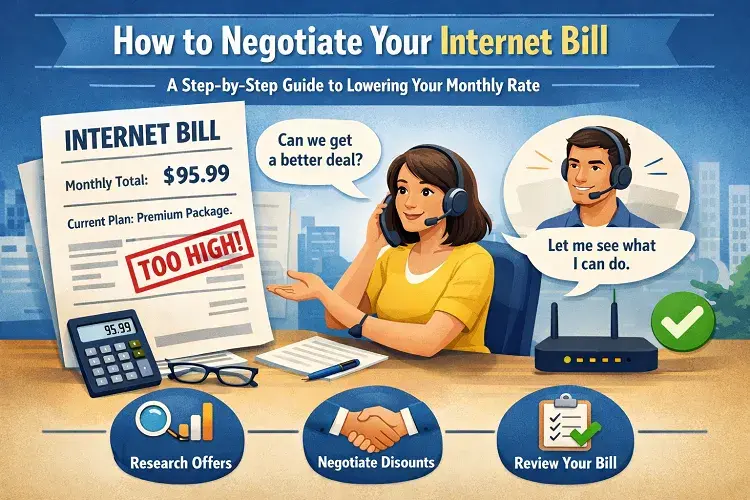
Step 1: Research Before You Call
Preparation is the single biggest factor in a successful negotiation. Providers take customers more seriously when they have done their homework.
Review your current bill in detail. Identify your plan name, advertised speeds, monthly rate, equipment rental fees, and any add-on charges. Knowing exactly what you are paying — and for what — prevents a customer service representative from redirecting the conversation.
Check what speeds you are actually receiving. Run a speed test from Ookla or Fast.com and document the results. If your actual speeds fall significantly below what you are paying for, you have a service quality issue in addition to a pricing issue — a stronger negotiating position.
Research competitor pricing in your area. Visit the websites of alternative providers serving your ZIP code and note their current promotional rates. Be specific: “Competitor X is offering 400 Mbps for $49.99 per month for new customers” carries more weight than a vague claim about cheaper options being available.
Know your account standing. Customers who pay on time and have been with a provider for multiple years are in a stronger position. Loyalty is real leverage — ISPs know that retaining an existing customer is far less expensive than acquiring a new one. Industry estimates suggest that acquiring a new broadband customer costs providers $250–$400 in marketing and installation costs.
For consumers looking to compare current plans and providers in their area, CompareInternetHub offers a free comparison tool to identify available options by ZIP code.
Step 2: Call the Retention Department Directly
Customer service agents and retention (also called “loyalty”) specialists operate under different mandates. Standard customer service representatives are focused on resolving issues; retention teams are authorised to offer discounts, promotional credits, and plan modifications to prevent cancellations.
When you call, ask directly: “I’d like to speak with the customer retention department.” If the representative you reach says they can handle everything, that is fine — but confirm they have access to retention-level offers.
When you call, have the following ready:
- Your account number
- The exact amount on your most recent bill
- Competitor pricing you’ve researched
- Your speed test results (if relevant)
- A willingness to be politely persistent
Verbal communication is more effective than email or live chat for negotiations. An agent has more discretion in a phone conversation and can apply discounts in real time that may not be accessible through other channels.
Step 3: Use a Clear, Confident Script
You do not need to be aggressive to be effective. The most successful negotiators are calm, direct, and specific. Here is a framework that works:
Opening: “Hi, I’ve been a customer for [X years], and I’ve noticed my monthly bill has gone up to [amount]. I’d like to talk about options for lowering it.”
Add leverage: “I’ve been looking at [Competitor Name], which is offering [speed] for [price] per month to new customers in my area. I’d prefer to stay with you, but I need my rate to be more competitive.”
Ask directly: “Is there a current promotional rate or loyalty discount you can apply to my account?”
Handle pushback: If the agent says no, ask: “Is there a manager or someone in your loyalty department I can speak with? I’d really like to avoid switching providers.”
Being polite but persistent matters. Some customers need to call two or three times before reaching an agent with the authority to approve a meaningful discount.
Step 4: Know What to Ask For
Negotiating a lower rate is not the only option. Several strategies can reduce your monthly total even when a straight discount isn’t available:
Request a promotional or loyalty rate. Many ISPs run rolling promotions that customer service agents can apply to existing accounts. These are not always advertised.
Ask about plan downgrades. If you are paying for 1 Gbps speeds but consistently using 100–200 Mbps, a lower-tier plan may cost $15–$30 less per month with no meaningful impact on your experience.
Eliminate equipment rental fees. Purchasing a compatible modem can save $10–$15 per month, often paying for itself within a year. Confirm compatibility with your ISP before purchasing.
Bundle strategically (or unbundle). If you are currently bundling services that include channels or features you don’t use, unbundling can reduce costs. Conversely, if a bundle adds a meaningful service at a lower combined rate, it may be worth pursuing.
Ask about senior, military, or low-income discounts. Many ISPs offer discounted plans for qualifying households. These programs are not always prominently advertised but are available to eligible customers who ask.
Customers who want support comparing plan options or confirming available discounts in their area can also reach the team at CompareInternetHub by calling (844) 817-0136.
Step 5: What to Do If Negotiation Fails
Not every call ends with a discount. If your ISP declines to lower your rate:
Threaten to cancel — and mean it. Informing a provider that you plan to switch to a competitor within 30 days often unlocks retention offers that weren’t available earlier in the conversation. This step carries more weight when you have identified a credible alternative.
Schedule a follow-up call. Customer service representatives change, and so do the promotions they have access to. Calling back in a few days with the same request occasionally produces a different outcome.
Actually, switch providers. If a genuine alternative exists in your area that offers equivalent service at a lower price, switching is often the fastest way to cut your bill. New customer promotions are real, and they are frequently more attractive than what a provider is willing to offer existing subscribers.
Use negotiation as a recurring practice. Most promotional rates applied after a negotiation last 12–24 months. Set a reminder to renegotiate when that period ends.
Research Insights: The Competitive Landscape in 2025
The broadband market has grown more competitive in meaningful ways. Fibre networks are expanding, fixed wireless access from T-Mobile and Verizon has emerged as a credible alternative to cable, and 5G home internet — averaging around $50 per month from major carriers — now applies real pricing pressure in markets where it is available.
According to USTelecom’s 2025 Broadband Pricing Index, industry-wide investment reached $89.6 billion in the previous year, and a majority of U.S. households (55.9%) now subscribe to plans between 100 Mbps and 940 Mbps. BroadbandNow data shows the inflation-adjusted price of fibre broadband has fallen 39% since 2015, and nominal fibre prices are down 19% over the same period.
These trends matter for negotiators: the existence of credible, lower-cost alternatives has given consumers more leverage than they have had in previous years. ISPs are aware of the competitive threat from fixed wireless and fibre expansion, and retention teams are more motivated to keep customers than the market dynamics of five years ago would suggest.
The Benton Institute’s analysis of FCC Urban Rate Survey data confirms that average broadband prices rose 4.8% in inflation-adjusted terms from 2024 to 2025 — driven significantly by the growth of high-speed tiers at 2 Gbps or more. For consumers not subscribing to those premium tiers, the data suggests room for negotiation exists at the mid-range of the market.
Consumer Impact: What Real Savings Look Like
A $20-per-month reduction in your internet bill adds up to $240 per year. A $40 reduction saves $480 annually. Over five years as a customer, even modest negotiation savings can amount to more than $1,000.
For households that combine cable and internet, that figure climbs further. Reviews.org’s 2025 consumer spending research found that the average American spends nearly $280 per month on internet, mobile, cable TV, and streaming combined — approximately $3,350 per year. Even marginal reductions in each service category produce meaningful annual savings.
Consumers who purchase their own modem equipment rather than renting from their provider can compound those savings, recovering the equipment cost within 12 months and saving $120–$180 per year thereafter.
Future Outlook: Will Internet Bills Keep Rising?
The trajectory of broadband pricing depends on several competing forces. Fibre expansion and fixed wireless competition continue to apply downward pressure on mid-tier cable pricing. At the same time, ISPs are actively encouraging subscribers to upgrade to premium high-speed tiers, where prices are substantially higher.
The end of the Affordable Connectivity Program (ACP) in May 2024 removed a $30/month subsidy that had benefited approximately 23 million households, and FCC data shows that the share of plans priced at $30 or below fell from 9% (during ACP) to just 3% in 2025. For budget-conscious consumers, this makes proactive negotiation even more important.
The FCC’s 2026 urban rate benchmark of approximately $96 per month for a 100/20 Mbps plan — up roughly $10 from the prior year — signals that regulatory expectations around broadband costs continue to rise alongside actual consumer prices. Consumers who do not actively manage their internet plan are likely to experience further rate increases.
Frequently Asked Questions
Can I really negotiate my internet bill?
Yes. Internet service providers routinely offer retention discounts, promotional rates, and loyalty credits to customers who ask. ISPs spend $250–$400 to acquire a new customer, which makes keeping an existing one economically important. Calling with documented competitor pricing and a polite but firm tone is often sufficient to secure a lower rate.
How much can I save by negotiating my internet bill?
Most consumers who call their ISP’s retention department save between $10 and $40 per month, according to BroadbandNow consumer research. Over 12 months, that equals $120–$480 in annual savings. Results vary by provider, market, account history, and negotiation approach.
What is the best thing to say when negotiating your internet bill?
State your current rate, reference a specific competitor offer in your area, and ask directly for a promotional or loyalty discount. Being specific and calm — rather than vague or aggressive — tends to produce better outcomes. Asking to speak with the retention department at the start of the call can also improve results.
Is it better to call or chat when negotiating an internet bill?
Phone calls are more effective. Verbal communication gives both parties more flexibility, and retention agents have broader authority to apply discounts in real-time conversations than through scripted chat channels. Plan for a call of 30–60 minutes, especially if escalation to a manager is needed.
What if my ISP refuses to lower my bill?
Ask to speak with a retention specialist or manager. If that fails, set a follow-up call for a different day — different representatives have different discretion. If no discount is available, switching to a competitor or using the threat of cancellation with a specific departure date often unlocks offers not mentioned initially.
Can I negotiate fees like modem rental charges?
Yes. Modem and router rental fees ($10–$15 per month) can often be waived if you agree to purchase your own compatible equipment. You can also ask your ISP to waive the rental fee as part of a broader retention offer. Confirm equipment compatibility before purchasing.
How often should I renegotiate my internet bill?
Every 12–24 months, or whenever your promotional period ends. Set a calendar reminder when any promotional rate is applied so you can renegotiate before the standard rate takes effect. Regular customers who negotiate annually typically maintain rates closer to new-customer pricing.
Do internet providers offer discounts for seniors or low-income households?
Many do. Programs like Xfinity’s Internet Essentials, AT&T Access, and Spectrum Internet Assist offer substantially reduced rates for qualifying households. These programs are not always prominently advertised; asking directly or checking the provider’s low-income assistance page is the most reliable way to confirm eligibility.
Conclusion
Negotiating your internet bill is one of the most accessible ways to reduce a fixed household expense with a single phone call. Armed with competitor pricing data, an understanding of your account standing, and a clear ask, most consumers can secure meaningful savings without switching providers. For those who do need to explore alternatives, the current broadband market — with expanding fibre networks and the growth of fixed wireless options — offers more genuine competition than has existed in previous years.
If you are unsure which providers are available in your area or want to compare current plan pricing before your next negotiation call, CompareInternetHub provides a free, ZIP-code-based comparison tool to help you identify alternatives and confirm the going rate for your market.
Updated on: May 31, 2026