Key Findings at a Glance
- The average monthly internet bill in Utah is approximately $70–$81, depending on plan type and provider.
- Utah is among the most competitively priced states for internet service relative to speeds offered.
- Fiber optic internet is available to roughly 47% of Utah households, well above the national average.
- Major providers serving the state include Xfinity, Google Fiber, Quantum Fiber (CenturyLink), UTOPIA Fiber, and Rise Broadband.
- Approximately 92.7% of Utah residents have access to wired or fixed wireless broadband at speeds of at least 25 Mbps.
What Is the Average Internet Bill in Utah?
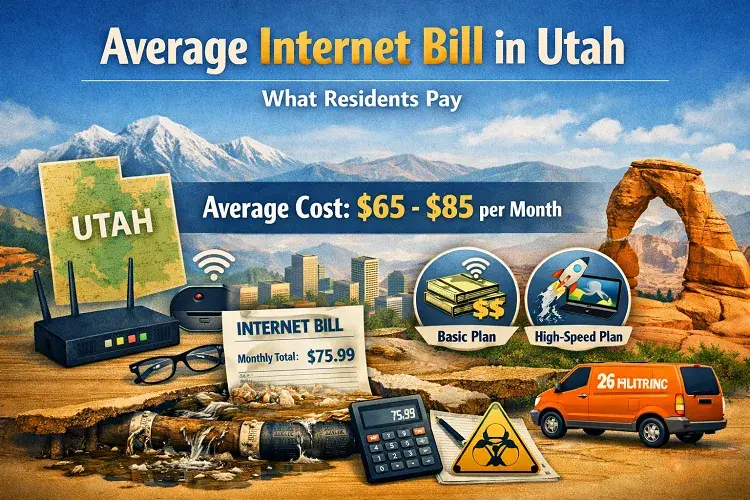
The average monthly internet bill in Utah falls between $70 and $81 per month for a standard residential broadband plan. Cost-of-living data compiled for 2025 places the state’s typical household internet expenditure at around $77 per month, while internet plans specifically for the Salt Lake City metro range from $35 on the low end to $100 or more for premium fiber tiers.
This places Utah slightly below the national median high-speed internet bill of $81 per month (per Consumer Reports analysis), making it one of the more affordable states on a value-per-dollar basis. According to HighSpeedInternet.com’s 2024 state rankings, Utah was among the top 10 cheapest states for internet relative to the speeds available — a notable distinction for a state that is not densely urbanized across its entire geography.
How Utah Internet Costs Break Down by Provider
Understanding what drives your monthly bill requires looking at individual provider pricing. Here is what major Utah internet service providers charge as of 2025:
Xfinity (Comcast)
Xfinity is the dominant cable internet provider in Utah, covering approximately 97–98% of Salt Lake City and most of the state’s populated areas. Plans range from $40 to $100 per month, with download speeds from 300 Mbps up to 2,000 Mbps. One notable consideration: Xfinity cable plans carry a data cap (1.2 TB/month), and subscribers must pay extra for the xFi Complete plan to remove data limits.
Google Fiber
Google Fiber is available in select Salt Lake City neighborhoods and surrounding areas, offering symmetrical fiber speeds starting at 1 Gbps for $70 per month, 2 Gbps for $100/month, and ultra-premium 5 Gbps and 8 Gbps tiers at $125 and $150 per month, respectively. The service comes with no contracts, no data caps, and no promotional pricing — the rate you sign up for is the rate you pay.
Quantum Fiber (formerly CenturyLink)
Quantum Fiber serves much of the Salt Lake Valley and surrounding communities, with fiber plans priced between $50 and $75 per month. Speeds range from 100 Mbps up to 940 Mbps on fiber, with no annual contracts on most plans. Legacy DSL plans are still active in some areas at lower speeds.
UTOPIA Fiber
UTOPIA (Utah Telecommunication Open Infrastructure Agency) is a publicly owned fiber network operating across 22+ Utah cities. Plans typically start at $65–$70 per month for gigabit speeds. Because UTOPIA is a wholesale network, services are delivered through retail provider partners, which can affect customer service experiences.
Rise Broadband
For rural and suburban Utah households outside fiber coverage zones, Rise Broadband offers fixed wireless internet starting as low as $25 per month, making it among the cheapest entry-level options in the state.
Utah vs. National Average Internet Costs
| Category | Utah Avg. | National Avg. |
|---|---|---|
| Monthly internet bill | ~$77/month | ~$81/month |
| Entry-level plan pricing | $25–$40/month | $30–$50/month |
| Fiber availability | ~47% of households | ~43% of households |
| Broadband access (any) | 92.7% | ~95% nationally |
Utah’s combination of competitive pricing and above-average fiber availability makes it a relatively strong broadband market by national standards. The state’s ranking of 13th in BroadbandNow’s annual coverage, speed, and availability index reflects this position.
Why Internet Bills Vary Across Utah
Not every Utah household pays the same amount. Several factors create meaningful cost differences across the state:
Geographic location is the primary driver. Salt Lake City, Provo, Ogden, and St. George enjoy competitive multi-provider markets where fiber, cable, and fixed wireless services compete for subscribers. Rural counties like San Juan, Emery, and Garfield often have far fewer options — sometimes only a single provider — which removes competitive pressure on pricing.
Technology type significantly affects both cost and performance. Fiber plans typically offer the best value on a dollars-per-Mbps basis, while legacy DSL plans (still common in some areas) can cost $50+ per month for speeds under 100 Mbps. Fixed wireless can be a cost-effective rural option, but it may involve speed variability.
Data caps and equipment fees inflate the actual monthly cost beyond the advertised plan price. Xfinity’s base cable plans include a 1.2 TB data cap; households that exceed it face overage charges. Equipment rental fees (typically $10–$15 per month for a modem/router) are also frequently added to base rates, an expense that can be avoided by purchasing your own compatible device.
Promotional vs. standard rates are another common source of sticker shock. Many providers offer introductory rates for 12–24 months that increase significantly at renewal. Consumers comparing plans through resources like CompareInternethub can identify which rates are promotional and what the standard long-term pricing looks like before committing.
Utah’s Broadband Infrastructure: What the Data Shows
Utah has made meaningful strides in broadband expansion. According to FCC Broadband Data Collection records, Utah has 1,018,752 broadband serviceable locations. Of those, 955,082 are considered served, while roughly 63,670 locations remain underserved or unserved — a gap the state’s Utah Broadband Center has been actively working to close through federal grant programs and the Utah Broadband Alliance.
The FCC’s December 2024 Broadband Data Collection report shows that nationally, 95% of homes now have access to speeds of 100/20 Mbps or greater — a benchmark Utah broadly meets in its urban and suburban corridors. The state ranked among the top 10 in CNBC’s 2024 infrastructure report, with evaluators noting that “Utah’s power grid is among the nation’s most reliable and broadband connectivity is excellent.”
Fiber access is a particular strength. Approximately 47% of Utah households have access to fiber-optic internet service, which compares favorably to the national average. The UTOPIA Fiber network, which spans more than 22 cities across the Wasatch Front and beyond, is one of the few publicly owned open-access fiber networks of its scale in the United States — a significant driver of competitive pricing and service quality in covered areas.
Ways Utah Residents Can Lower Their Internet Bill
Shop competitive markets. Households in Salt Lake City, Provo-Orem, and Ogden-Clearfield metros often have three or more viable providers. Regularly comparing plans through services like CompareInternethub ensures you’re not overpaying when a better deal is available at your address.
Buy your own modem and router. Most providers charge $10–$15 per month in equipment rental fees. A one-time purchase of compatible equipment pays for itself within 12–18 months.
Check ACP and Lifeline eligibility. The Affordable Connectivity Program (ACP) provided significant discounts for qualifying low-income households, and while its federal funding ended in 2024, some providers continue to offer reduced-rate plans for income-qualifying customers. The FCC’s Lifeline program also remains active for voice and broadband discounts.
Negotiate at renewal. When a promotional period ends and the rate increases, calling the provider’s retention department often yields a new promotional rate or plan adjustment. Providers are motivated to retain subscribers in competitive markets.
Consider the speed tier carefully. Many households subscribe to plans faster than they actually need. A household of two people primarily streaming video and working from home can function well on 200–300 Mbps, a tier that costs considerably less than gigabit plans marketed to heavy users.
Internet Costs in Utah’s Major Cities
| City | Common Providers | Typical Monthly Range |
|---|---|---|
| Salt Lake City | Google Fiber, Quantum Fiber, Xfinity, UTOPIA | $40–$100 |
| Provo | Google Fiber, Xfinity, UTOPIA | $40–$100 |
| Ogden | Xfinity, Quantum Fiber, UTOPIA | $40–$80 |
| St. George | Xfinity, Quantum Fiber | $40–$80 |
| Logan | Xfinity, Quantum Fiber | $40–$75 |
| Rural Utah | Rise Broadband, Starlink, HughesNet | $25–$120 |
Future Outlook: Where Utah Internet Pricing Is Headed
Several trends are likely to shape Utah’s internet costs over the next several years.
Fiber expansion continues aggressively. UTOPIA Fiber is actively expanding into new cities, and Quantum Fiber has been rebranding and upgrading CenturyLink’s legacy DSL footprint to fiber. As fiber availability increases, it tends to drive down cable and DSL pricing in adjacent service areas through competitive pressure.
Fixed wireless and 5G home internet — services from providers like T-Mobile Home Internet — are emerging as meaningful alternatives in semi-rural Utah markets, often priced at $50–$60 per month with no contracts and no data caps. As 5G coverage expands across the state, these services are expected to reach more households that currently lack strong wired options.
Federal infrastructure investment through the BEAD (Broadband Equity, Access, and Deployment) program funding is also channeling significant resources into Utah’s unserved and underserved communities. As more of the state gains access to multiple competitive providers, average monthly costs are likely to remain stable or decline modestly in real terms.
Frequently Asked Questions
What is the average internet bill in Utah per month?
The average internet bill in Utah is approximately $70–$81 per month for a standard residential plan. Actual costs vary based on provider, plan speed, location, and whether promotional pricing is in effect. Fiber plans in major cities can start as low as $40/month, while rural fixed wireless options may range from $25 to $60/month.
Who are the major internet providers in Utah?
The primary internet providers in Utah are Xfinity (cable), Google Fiber (fiber), Quantum Fiber/CenturyLink (fiber and DSL), UTOPIA Fiber (publicly owned fiber), and Rise Broadband (fixed wireless). Availability varies significantly by city and zip code; urban areas like Salt Lake City often have four or more viable options.
Is the internet in Utah cheaper than the national average?
Yes, generally. Utah internet costs are slightly below the national median. HighSpeedInternet.com ranked Utah among the top 10 cheapest states for internet value in 2024, factoring in the speeds available relative to the price paid. This is partly driven by the state’s robust fiber infrastructure and multi-provider competition in urban markets.
Is fiber internet available in Utah?
Yes. Approximately 47% of Utah households have access to fiber-optic internet, which is above the national average. Providers include Google Fiber, Quantum Fiber, UTOPIA Fiber, and EarthLink Fiber. Availability is concentrated in the Wasatch Front urban corridor and is expanding to additional cities through the UTOPIA network and private investment.
What is UTOPIA Fiber in Utah?
UTOPIA (Utah Telecommunication Open Infrastructure Agency) is a publicly owned, open-access fiber network serving more than 22 Utah cities. Because it operates as a wholesale network, multiple retail providers offer service over the UTOPIA infrastructure, which fosters competition and competitive pricing. Gigabit service is typically available starting around $65–$70/month.
Does Xfinity have data caps in Utah?
Yes. Xfinity’s standard cable internet plans in Utah include a 1.2 terabyte monthly data cap. Customers who exceed the cap face overage charges. Subscribers can avoid this by upgrading to xFi Complete, which adds unlimited data for an additional monthly fee. Fiber providers like Google Fiber and UTOPIA Fiber generally offer unlimited data with no caps.
How can I lower my internet bill in Utah?
Strategies include switching to a competing provider, purchasing your own modem and router instead of renting, negotiating a new rate at the end of your promotional period, checking eligibility for income-based discount programs like FCC Lifeline, or downgrading to a lower speed tier that still meets your household’s actual usage needs.
What internet speed do most Utah households need?
For a household of two to four people engaged in typical activities — streaming video, video conferencing, and browsing — 200–500 Mbps download is typically sufficient. Households with multiple simultaneous 4K streams, remote workers with heavy upload needs, or gamers may benefit from gigabit plans. Working-from-home professionals with video call-heavy schedules should prioritize upload speed, making fiber (which offers symmetrical upload/download) particularly valuable.
Conclusion
Utah residents pay an average of roughly $70–$81 per month for internet service — a figure that sits at or below the national median, bolstered by a competitive broadband market anchored by Google Fiber, Quantum Fiber, Xfinity, and the state’s unique UTOPIA Fiber network. Fiber availability at 47% of households gives Utah a meaningful infrastructure advantage over many states of its size.
That said, costs vary considerably. Salt Lake City residents may find gigabit fiber for $70/month, while rural households in less-served counties may pay comparable rates for far slower fixed wireless connections. Understanding what’s available at your specific address — and whether a better option exists — remains the most direct path to reducing your monthly bill.
For detailed provider comparisons, plan pricing, and availability by zip code, CompareInternethub provides current data to help Utah households make informed decisions about their broadband service.
More Internet Billing & Connectivity Guides
Compare State Averages: Are you overpaying for broadband? Compare your monthly statement against the Average Internet Bill in Utah and the Average Internet Bill in Alabama to see if it is time to switch providers.
Find Discounts & Specialized Plans: Don’t get caught off guard by price hikes—find out How Much Frontier Internet Costs After 12 Months. Also, check out our curated lists for Internet Provider Discounts for Students and the absolute Best Internet Plans for Remote Workers.
Updated on: August 1, 2026