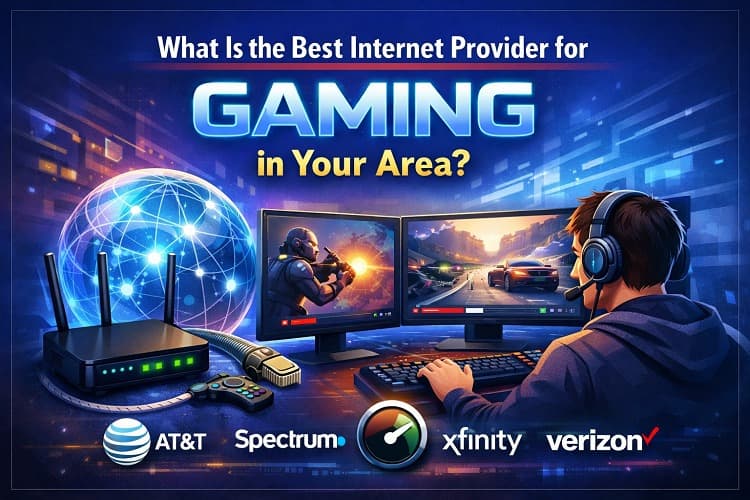
If you’ve ever lost a ranked match because of rubber-banding, high ping, or sudden disconnects, you know one thing: your internet provider makes or breaks the experience. In 2026, competitive gaming demands more than just “fast” speeds. You need ultra-low latency, rock-solid reliability, and symmetrical upload/download performance—especially when streaming your gameplay or playing with friends.
The truth? There is no single “best” internet provider for gaming that works for every gamer in the USA. The winner depends on what’s available at your exact address. This guide cuts through the marketing noise to show you exactly how to choose the right ISP for your area, the top providers dominating 2026 leaderboards, and step-by-step ways to find the perfect plan.
Why Internet Quality Matters More Than Ever for Gaming in 2026
Modern games like Call of Duty, Fortnite, League of Legends, Valorant, and cloud gaming platforms (GeForce Now, Xbox Cloud) are extremely sensitive to three things:
- Latency (ping): Time it takes for your actions to register on the server. Under 20 ms is ideal for competitive play; 30–50 ms is playable; anything higher feels laggy.
- Speed & Bandwidth: A minimum of 100 Mbps download is recommended, but 300–1,000+ Mbps is better for 4K streaming, downloads, and multiple devices.
- Stability (jitter & packet loss): Consistent performance during peak evening hours when everyone is online.
Fiber-optic internet crushes cable or 5G home internet here because it uses light instead of electricity or radio waves—resulting in symmetrical speeds and minimal interference.
How We Choose the Best Gaming Internet Providers
We evaluate providers using real-world data from 2026 independent tests (PCMag Readers’ Choice, CNET, BroadbandNow, and speed-test aggregates). Our strict criteria include:
- Average latency under 20 ms where possible
- Symmetrical upload/download speeds (fiber preferred)
- No data caps or generous allowances
- Consistent performance during peak hours
- Wide availability + competitive pricing
- High customer satisfaction scores for gaming reliability
We ignore pure marketing claims and focus on what actually delivers wins in-game.
Top Gaming Internet Providers in the USA (2026)
Here are the standout providers that consistently rank highest for gamers. All offer plans starting around 300 Mbps–multi-gig speeds. Availability is key—fiber is ideal, but not everywhere.
- GFiber (formerly Google Fiber) – Best Overall Gaming ISP GFiber’s pure fiber network delivers symmetrical multi-gig speeds (up to 8 Gbps in select areas) with exceptional stability and reader satisfaction scores topping 9.5/10 in 2026 PCMag rankings. Their process uses direct fiber-optic lines straight to your home, eliminating bottlenecks and delivering median latency around 5–10 ms. No contracts, no data caps, and free Wi-Fi 7 equipment on higher plans. Perfect for serious gamers and streamers. Limited but expanding footprint—check your ZIP.
- Verizon Fios – Lowest Latency Champion Verizon Fios runs a 100% fiber-optic network with the lowest average latency among major providers (often 13–18 ms). Plans range from 300 Mbps to 2 Gbps+ symmetrical speeds with zero data caps. Their direct-to-home fiber process minimizes jitter and packet loss, making it the top pick for competitive shooters and esports. Widely available in the Northeast, Mid-Atlantic, and parts of the South. Often praised by CNET as the best overall for gamers.
- AT&T Fiber – Best Nationwide Fiber Availability. AT&T Fiber offers symmetrical speeds up to 5 Gbps with consistently low latency (5–15 ms). Their fiber deployment process brings high-capacity connections directly to homes across 22+ states, supporting multiple devices without slowdowns. Strong during peak hours and great for cloud gaming. Plans start affordably, with no annual contracts on most tiers.
- Frontier Fiber – Best Value Fiber Expansion Frontier has aggressively expanded its fiber footprint with plans up to 2–5 Gbps and a latency typically 8–18 ms. Their pure-fiber process avoids the shared bandwidth issues of cable networks. Competitive pricing and no data caps make it a favorite where it’s available. Excellent for budget-conscious gamers who still want pro-level performance.
- Xfinity (Comcast) – Best Cable Alternative for Wide Availability When fiber isn’t an option, Xfinity’s DOCSIS 3.1/4.0 cable network delivers gigabit speeds (up to 2 Gbps) with solid latency (10–25 ms). Their hybrid fiber-coaxial process reaches 40+ states and offers “unlimited” data on most plans. Great for casual and mid-tier gaming; not quite as consistent as fiber during peak hours, but widely available and often the fastest non-fiber choice.
- Spectrum – Best No-Contract Cable Option. Spectrum provides reliable gigabit cable speeds with no data caps or contracts in most markets. Latency typically lands in the 15–25 ms range. Their network upgrades focus on consistent performance for streaming and gaming. Excellent coverage in 41 states—ideal if you want simple, affordable service without long-term commitments.
Pro Tip: Fiber providers (GFiber, Verizon Fios, AT&T, Frontier) almost always outperform cable for competitive gaming. Use 5G home internet or satellite only as a last resort—they introduce higher and more variable latency.
How to Find the Best Internet Provider for Gaming in Your Area (Step-by-Step)
- Enter your ZIP code on comparison sites like CompareInternethub.com
- Check availability by full address—coverage can vary street-by-street.
- Compare plans side-by-side: Look at actual speeds, latency reports, price after promo, equipment fees, and data caps.
- Read recent customer reviews focused on gaming performance in your city.
- Test your current connection with tools like Ookla Speedtest (ping + jitter) and compare.
- Contact shortlisted providers for exact quotes and installation timelines (fiber installs usually take 1–2 weeks).
Many providers offer free installation or gift cards for switching—ask about gamer-specific promos.
Quick Setup Tips for Lag-Free Gaming
- Use a wired Ethernet connection instead of Wi-Fi whenever possible.
- Place your router centrally and upgrade to Wi-Fi 6E or 7 if using wireless.
- Enable QoS (Quality of Service) settings to prioritize gaming traffic.
- Close background downloads and apps during play sessions.
- Consider a gaming router with low-latency features if you have multiple devices.
FAQ: Best Internet for Gaming in Your Area
Q: What internet speed do I actually need for gaming? A: 100 Mbps download and 10+ Mbps upload is sufficient for most gamers. Competitive players should aim for 300 Mbps+ with symmetrical fiber for the smoothest experience.
Q: Is fiber really worth it over cable for gaming? A: Yes—fiber delivers lower latency, symmetrical speeds, and better consistency. Cable works fine for casual play, but fiber wins for ranked matches and tournaments.
Q: How do I check which providers are in my area? A: Simply enter your ZIP code or address on comparison websites. Results show real-time availability, speeds, and prices.
Q: Can 5G home internet work for gaming? A: It can for casual gaming (latency 20–60 ms), but it’s less reliable than wired fiber or cable due to signal variability. Not recommended for competitive play.
Q: What’s the biggest mistake people make when choosing a gaming internet? A: Choosing based only on advertised speed instead of latency and real-world reliability. Always verify local performance reviews.
Q: Do any providers offer gaming-specific plans? A: Most don’t have “gaming-only” plans, but fiber providers like Verizon Fios and GFiber are engineered for low-latency applications and perform best.
Q: How long does it take to switch providers? A: Usually 1–3 weeks, including installation. Many offer same-day or next-day activation on existing cable lines.
Ready to Upgrade Your Gaming Setup?
The best internet provider for gaming in your area is the one that delivers the lowest latency and highest reliability right at your address. In 2026, fiber rules the leaderboard—but only if it’s available where you live.
Don’t settle for lag that costs you games. Enter your ZIP code on a trusted comparison site today, compare the top providers listed above, and lock in the connection that lets you play at your absolute best.
Game on—and may your ping stay forever low.
Updated on: May 4, 2026