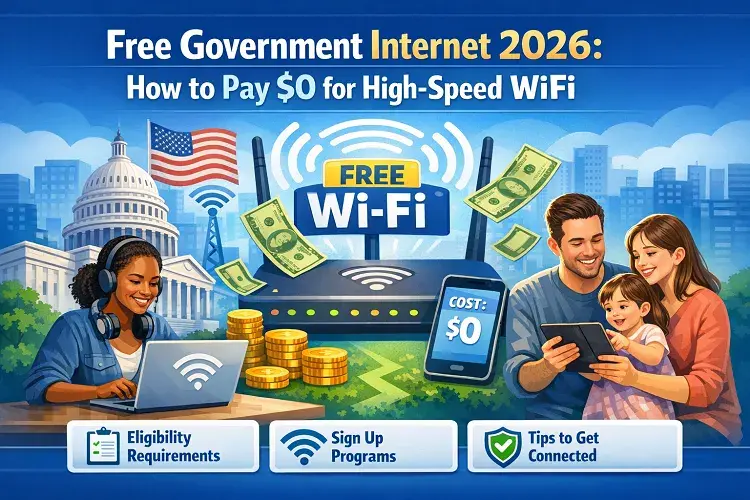
Can I get free internet in 2026? Yes. While the Affordable Connectivity Program (ACP) is no longer active, the FCC Lifeline Program remains permanent. Eligible low-income households receive a $9.25 monthly subsidy ($34.25 on Tribal Lands). By applying this credit to “Safety Net” plans from providers like Xfinity, Spectrum, or AT&T, your total monthly cost can drop to $0.00.
Connectivity is no longer a luxury; it is a fundamental utility, akin to electricity and water. In 2026, the ability to apply for a job, attend a classroom, access healthcare via telehealth, and participate in the modern economy is entirely dependent on having a reliable, high-speed internet connection at home.
However, for millions of American households, the high cost of broadband remains a significant barrier. The expiration of the Affordable Connectivity Program (ACP) in 2024 left a massive void in federal assistance. This 2,200-word guide is designed to be the definitive resource for 2026, helping you navigate the permanent programs, state-level initiatives, and private-sector plans that can bring your internet bill down to zero.
The Federal Lifeline Program (The Permanent Foundation)
While the ACP was a temporary pandemic-era relief measure, the Lifeline program is a permanent federal benefit that has existed since 1985. Managed by the Universal Service Administrative Company (USAC) under the direction of the FCC, Lifeline is the primary foundation upon which all free internet strategies are built in 2026.
What Lifeline Provides in 2026
Lifeline provides a monthly discount on either phone service, internet service, or a bundled package.
- Standard Discount: $9.25 per month.
- Tribal Lands Discount: Up to $34.25 per month for residents of qualifying Tribal lands.
In-Depth Eligibility Criteria
To qualify for Lifeline in 2026, your household must meet at least one of the following criteria:
1. Income-Based Eligibility: Your annual household income must be at or below 135% of the 2026 Federal Poverty Guidelines. For a household of four in the 48 contiguous states, this typically means a total income of approximately $42,000 or less.
2026 Lifeline Income Table (Estimated)
| Household Size | 48 States (135%) | Alaska (135%) | Hawaii (135%) |
|---|---|---|---|
| 1 Person | ~$20,331 | ~$25,420 | ~$23,382 |
| 2 People | ~$27,513 | ~$34,411 | ~$31,644 |
| 3 People | ~$34,695 | ~$43,402 | ~$39,906 |
| 4 People | ~$41,877 | ~$52,393 | ~$48,168 |
2. Program-Based Eligibility If you or someone in your household participates in any of the following federal assistance programs, you are automatically eligible for Lifeline:
- SNAP (Supplemental Nutrition Assistance Program): Formerly known as Food Stamps.
- Medicaid: State-run health insurance for low-income individuals.
- SSI (Supplemental Security Income): For aged, blind, or disabled individuals with little or no income.
- Federal Public Housing Assistance (FPHA): Including Section 8 and other HUD-managed housing.
- Veterans Pension and Survivors Benefit: Specifically for low-income veterans.
- Tribal-Specific Programs: Including Bureau of Indian Affairs General Assistance, Tribal TANF, and Food Distribution Program on Indian Reservations.
The Post-ACP “Private” Marketplace
When the ACP ended, many feared that low-income families would be forced back into $80/month internet bills. However, the market responded. Realizing that connected customers are better for the economy, every major Internet Service Provider (ISP) in the U.S. launched or expanded “Digital Equity” plans.
These are not government programs; they are voluntary, low-cost tiers offered by the companies themselves.
Detailed ISP Plan Breakdown (2026)
1. Xfinity Internet Essentials (Comcast)
Xfinity remains the gold standard for low-income connectivity.
- Speed: 50 Mbps down / 10 Mbps up.
- Price: $9.95/month (Plus tax).
- The “Zero” Strategy: If you apply your $9.25 Lifeline credit to this plan, your monthly out-of-pocket cost is effectively $0.70.
- Perks: Includes a free Wi-Fi router, no credit check, and no contracts.
2. Access from AT&T
AT&T offers one of the fastest low-income tiers available in 2026.
- Speed: Up to 100 Mbps.
- Price: $30.00/month.
- Eligibility: Must participate in SNAP, SSI, or have a household income below 200% of the poverty line.
- Zero Strategy: By using the Lifeline credit and AT&T’s internal “Affordability Grant,” many customers pay $0.
3. Spectrum Internet Assist
Spectrum’s plan is designed specifically for seniors and families with children.
- Speed: 50 Mbps.
- Price: $24.99/month.
- Eligibility: Limited to households with a member in the National School Lunch Program (NSLP) or those receiving SSI (Aged 65+).
4. Cox Connect2Compete
A highly focused program for families with K-12 students.
- Speed: 100 Mbps.
- Price: $9.95/month.
- Requirement: Must have at least one K-12 student in the household and participate in a qualifying government program.
The 2026 Reality: Life After the ACP
If you are searching for “free government internet,” you’ve likely seen news about the ACP ending. In 2026, the strategy for CompareInternetHub users is simple: The Subsidy Stack.
You no longer need to look for a single “magic” program. Instead, you combine Federal Aid (Lifeline) with Private ISP Discounts. This combination is the only reliable way to get high-speed internet for under $10 a month.
Top USA Low-Income Internet Plans (2026)
We have vetted the top providers in the USA. Use the table below to find the plan that fits your budget after the $9.25 Lifeline discount is applied.
| Provider | Plan Name | Speed | Base Price | Price After Lifeline | Best For… |
| Xfinity | Internet Essentials | 50 Mbps | $9.95 | $0.70 | Absolute Lowest Cost |
| Spectrum | Internet Assist | 50 Mbps | $24.99 | $15.74 | Seniors (SSI) |
| AT&T | Access | 100 Mbps | $30.00 | $20.75 | Large Families |
| Verizon | Verizon Forward | 300 Mbps | $20-$40 | Varies | Fiber Reliability |
| Optimum | Optimum Advantage | 50 Mbps | $14.99 | $5.74 | Easy Application |
Step-by-Step: How to Secure Your $0 Plan
To move from “looking” to “connected,” follow this 3-Step Transactional Roadmap.
Step 1: Verify Your Eligibility
You automatically qualify for the Lifeline subsidy if your household income is at or below 135% of the Federal Poverty Guidelines or if you participate in:
-
SNAP (EBT/Food Stamps)
-
Medicaid
-
SSI (Supplemental Security Income)
-
Federal Public Housing Assistance
-
Veterans Pension or Survivors Benefit
Step 2: Get Your National Verifier ID
Go to LifelineSupport.org.
-
Value Tip: Have a digital photo of your 2025/2026 Benefit Award Letter ready.
-
The Goal: You need a “Qualified” status and an Application ID.
Step 3: Trigger the “Hub” Connection
Once approved, do not call a standard salesperson. Call the Specific Assistance Departments listed here:
-
Xfinity Essentials: 1-855-846-8376
-
Spectrum Assist: 1-844-579-3743
-
AT&T Access: 1-855-220-5211
Added Value: Hidden 2026 Perks
At CompareInternetHub, we go beyond the basic subsidy. Here are three “insider” ways to save more:
-
Free Laptops: Approved Lifeline users can often get a $100 discount toward a laptop or tablet through partners like PCs for People.
-
No Credit Checks: Most 2026 low-income tiers from Xfinity and Spectrum do not require a credit check or a deposit.
-
Unlimited Hotspots: Many of these plans include free access to millions of WiFi hotspots nationwide, helping you save on your mobile data bill.
How to Apply Government Subsidies to 5G Home Internet
Yes. In 2026, you can apply your $9.25 federal Lifeline subsidy to 5G Home Internet plans from carriers like Verizon and T-Mobile (via their Assurance Wireless or Project 10Million brands). While the ACP has ended, the Verizon Forward and T-Mobile Project 10Million programs act as private “Safety Net” plans that, when combined with Lifeline, can reduce your monthly bill to $20.00 or less.
The “Subsidy Stack” for Wireless Internet
In 2026, getting “Free” 5G internet requires stacking federal aid with provider-specific low-income programs. Here is how the top two 5G carriers handle this:
1. Verizon 5G Home Internet (Verizon Forward)
Verizon offers the Verizon Forward discount to any customer who is eligible for Lifeline, SNAP, WIC, or SSI.
-
The Deal: You can receive a discount of up to $30/month on 5G Home or LTE Home plans.
-
The Cost: If you qualify for both Lifeline ($9.25) and Verizon Forward ($30.00), your $50 or $60 plan can drop significantly, sometimes reaching a net cost of $20/month with all equipment included.
-
How to Apply: First, get your National Verifier ID at
LifelineSupport.orgThen, visit the Verizon Forward portal to link your status.
2. T-Mobile (Project 10Million & Assurance Wireless)
T-Mobile focuses its low-income efforts on students and mobile-first households.
-
Project 10Million: This is a 2026 flagship program for families with students in the National School Lunch Program. It provides a Free 5G Hotspot and 200GB of high-speed data per year for five years at $0 cost.
-
Assurance Wireless: This is T-Mobile’s dedicated Lifeline brand. It provides a free smartphone and a monthly data plan that can be used as a mobile hotspot for home Wi-Fi.
5G Wireless vs. Wired Fiber: Which is Better for Low-Income Users?
| Feature | 5G Home Internet (Wireless) | Fiber/Cable (Wired) |
| Installation Fee | $0 (Self-Install) | $50 – $100 (Professional) |
| Contracts | No Contracts | Often 12-month terms |
| Stability | Depends on Cell Signal | Highly Stable |
| Best For… | Renters & Mobile Households | Large Families & Gamers |
1. Is the ACP coming back?
As of mid-2026, there is no legislation to restart the ACP. Most experts believe that instead of a new national program, the government will continue to fold internet subsidies into the permanent Lifeline program and use BEAD funding to encourage state-level solutions.
2. Can I get free internet if I am a student?
Yes, but typically through your household. If you are a dependent student and your family participates in SNAP or the National School Lunch Program, your household qualifies for every major low-income internet plan.
3. Does free government internet have data limits?
Generally, no. In 2026, most major ISPs have removed data caps from their low-income tiers (like Internet Essentials) to ensure students and workers don’t lose access mid-month.
4. What is the fastest “free” plan available?
Access from AT&T currently offers speeds up to 100 Mbps, which is the fastest tier commonly available to low-income subscribers.
5. Can I use Lifeline for my cell phone and my home internet?
No. Federal rules limit one Lifeline discount to one service per household. You must choose whether to apply the $9.25 to your mobile bill or your home Wi-Fi bill.
6. What if I am denied by the National Verifier?
Denials are usually due to “information mismatch” (e.g., your address on your ID doesn’t match your utility bill). You can appeal by submitting a “Benefit Verification Letter” from the agency that provides your SNAP or Medicaid.
7. Is there free internet for seniors on Social Security?
If you receive Supplemental Security Income (SSI), you are automatically eligible. If you only receive standard Social Security retirement benefits, you must qualify based on your total annual income being below 135% of the poverty line.
8. Can I get free internet if I am homeless?
Yes. You can use a temporary address (like a shelter or a relative’s home) to apply for Lifeline. Many Lifeline providers also offer mobile hotspots that do not require a permanent wall outlet.
9. Do I need a credit check for low-income internet?
Most “Digital Equity” plans, such as Xfinity Internet Essentials and Spectrum Internet Assist, specifically waive credit checks to make the service accessible to everyone.
10. Can I get Starlink for free?
Starlink does not currently participate in the federal Lifeline program. However, some Tribal communities have received federal grants to provide Starlink hardware and service to their members for free or at a deep discount.
11. How long does the Lifeline approval take?
If the system can verify you automatically, it takes less than 10 minutes. If you have to upload documents, it typically takes 1 to 3 business days for a manual review.
12. Do I have to reapply every year?
Yes. You must recertify your eligibility every year. You will receive a notice via mail or email from USAC. If you ignore this notice, your discount will be removed from your bill.
13. What is the difference between Lifeline and Link Up?
Lifeline is a monthly discount on your bill. Link Up is a one-time discount of up to $100 to help pay for the cost of installing the internet in your home (available only on Tribal lands).
14. Can I use the Lifeline discount for 5G Home Internet?
Yes. Providers like T-Mobile and Verizon allow you to apply the federal Lifeline discount to their 5G Home Internet service, provided you meet the eligibility requirements.
15. Is there a “Free Internet” program for veterans?
Veterans who receive a Veterans Pension or Survivors Benefit are automatically eligible for the federal Lifeline discount and most ISP low-income plans.
16. Does New York have a special free internet law?
Yes, the New York Affordable Broadband Act requires ISPs to offer a $15/month plan to low-income residents, which becomes significantly cheaper when combined with the federal Lifeline credit.
17. What speed do I need for Zoom or Microsoft Teams?
For reliable video conferencing, you need at least 10-25 Mbps download speed. All the low-income plans mentioned in this guide (50 Mbps+) are more than sufficient for remote work and schooling.
18. Can I get a free laptop with my internet?
Some providers and non-profits offer deeply discounted laptops (e.g., $149), but truly “free” laptops are rare and usually limited to specific local charity programs or specific school district initiatives.
19. What happens if I move?
Your Lifeline benefit is tied to your person, not the house. You can transfer your benefit to a new provider at your new address, but you must update your information with the National Verifier.
20. Is the internet quality worse on these free plans?
No. You are using the same fiber or cable lines as every other customer. The only difference is the speed tier (e.g., 50 Mbps instead of 1,000 Mbps) and the discounted price.
Conclusion: Take Control of Your Connection
The transition to a post-ACP world has been challenging, but in 2026, the pathways to affordable internet are more stable than ever. By leveraging the permanent Lifeline program and the specialized low-income tiers offered by major ISPs, you can ensure that your household remains connected to the essential services of the modern age.
Don’t let the high cost of technology stand in your way. Use the roadmap provided in this guide to verify your eligibility, secure your discount, and pay $0 for the high-speed WiFi your family deserves.
More Affordable Internet Guides
Find Budget-Friendly Plans: You shouldn’t have to overpay to stay connected. Read our complete guide to The Best Internet Providers for Seniors, or see if you qualify for the Spectrum Low-Income Internet $30 Plan.
Government Assistance: Did you know you might qualify for free connectivity? Learn what the Emergency Broadband Benefit Is and discover how to Get Free Government Internet.
Updated on: July 31, 2026