2026 Showdown Verdict
AT&T Fiber vs. Spectrum: Which Wins in 2026?
Spectrum: 4.0 / 5 ⭐
The Bottom Line: If AT&T Fiber is available at your address, it beats Spectrum on almost every technical metric. AT&T delivers 100% symmetrical upload/download speeds (up to 5,000 Mbps), ultra-low ping latency (3–8ms), included Wi-Fi 6 hardware ($0/mo), and straightforward flat-rate pricing with no 2nd-year rate spikes. However, Spectrum Internet remains an excellent cable fallback with wider physical availability (covering 41 states), zero data caps, free modem hardware, and aggressive introductory bundling that includes a free Spectrum Mobile unlimited phone line for 12 months.
Choose AT&T Fiber If:
- You work from home, game online, or upload large video files
- You want transparent pricing with zero 2nd-year price hikes
- You want Wi-Fi router equipment included free ($0/mo)
Choose Spectrum If:
- Pure fiber is not yet built to your home address
- You want a free unlimited mobile phone line for 12 months
- You want contract buyout reimbursement up to $500
These two telecom giants dominate the market, but beneath their massive advertising budgets, they operate on completely different technological foundations. Spectrum relies on a legacy Cable network that has been upgraded over the years, while AT&T is rapidly expanding a pure Fiber-Optic network.
If you are tired of Zoom calls buffering or your internet bill skyrocketing every 12 months, you need to understand the technical differences between these two infrastructures.
100% Pure Optical Fiber
AT&T Fiber
No 2nd-Year Price Increase
- Speeds from 300 to 5,000 Mbps
- 100% symmetrical upload and download
- BGW320 Wi-Fi 6 Gateway included ($0/mo)
- Zero data caps or annual contracts
Nationwide Cable Network
Spectrum Internet
Includes 1 Free Mobile Line (12 Mos)
- Speeds from 300 to 1,000 Mbps
- Widespread physical availability (41 states)
- Free cable modem included
- Zero data caps or contracts
Here is the complete Compare Internet Hub engineering breakdown of AT&T vs. Spectrum for 2026, and why one provider holds a massive technological advantage.
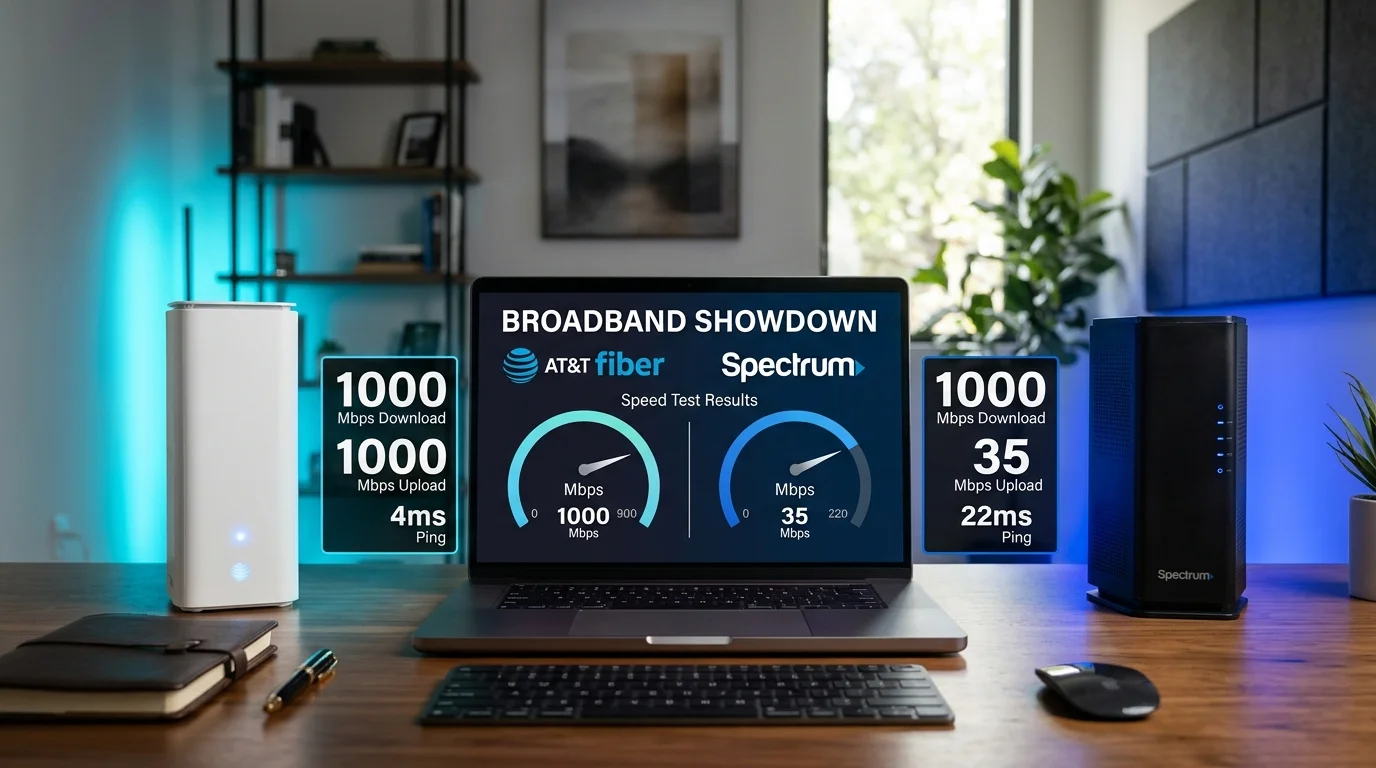
1. The Technology: DOCSIS 3.1 vs. Pure Fiber (FTTH)
AT&T Fiber vs. Spectrum Internet: Speed Tiers & Real Costs
2026 Plan Matchup
| Speed Tier | AT&T Fiber (FTTH) | Spectrum Cable (HFC) | Upload Speeds | Order Hotline |
|---|---|---|---|---|
| 300 Mbps Plan Everyday Streaming & WFH |
$55.00/mo No 2nd-year hike |
$39.99 – $50.00/mo Jumps to ~$80/mo Yr 2 |
AT&T: 300 Mbps Spectrum: 10 Mbps |
Call AT&T Call Spectrum |
| 500 Mbps Plan Multi-Device Households |
$65.00/mo No 2nd-year hike |
$49.99 – $70.00/mo (Ultra) Jumps to ~$100/mo Yr 2 |
AT&T: 500 Mbps Spectrum: 20 Mbps |
Call AT&T Call Spectrum |
| 1 Gig (1,000 Mbps) ⭐ Top Recommendation |
$80.00/mo $0 Router • Unlimited Data |
$69.99 – $90.00/mo (Gig) Jumps to ~$120/mo Yr 2 |
AT&T: 1,000 Mbps (Symmetrical) Spectrum: 35 Mbps |
Order AT&T Order Spectrum |
| 2 Gig Tier Multi-Gigabit Power |
$145.00/mo Symmetrical 2,000M |
Not Available on Cable | AT&T: 2,000 Mbps Spectrum: N/A |
Get 2 Gig |
| 5 Gig Tier Ultimate Multi-Gigabit |
$245.00/mo Pure Fiber Extreme |
Not Available on Cable | AT&T: 5,000 Mbps Spectrum: N/A |
Get 5 Gig |
*AT&T prices include AutoPay & Paperless billing discount. Neither provider enforces monthly data caps. Spectrum promotional rates typically increase by $25.00–$30.00/mo after 12–24 months. Spectrum Wi-Fi router is $7.00/mo extra (modem is free).
The core difference between these two companies is the physical wire delivering the internet to your house.
Spectrum: Hybrid Fiber-Coaxial (HFC)
Spectrum operates a Hybrid Fiber-Coaxial network. While they use high-speed fiber-optics for their main neighborhood lines, the final connection from the street to your modem is made using traditional copper coaxial cable. Spectrum utilizes DOCSIS 3.1 technology to push internet through this copper wire.
- The Problem: Because copper cables have limited bandwidth, you share this neighborhood copper line with your neighbors. This often leads to noticeable "congestion throttling" between 7:00 PM and 10:00 PM when everyone on your street is streaming Netflix.
AT&T Fiber: Fiber-to-the-Home (FTTH)
If you qualify for AT&T Fiber, you are connecting to a 100% fiber-optic network. Instead of copper, AT&T runs a buried glass cable directly into your home. Data is transmitted via pulses of light.
- The Advantage: Light does not suffer from electronic interference or neighborhood congestion. If you pay for 1 Gigabit of speed from AT&T, you will receive 1 Gigabit of speed, even at 8:00 PM on a Friday.
2. Symmetrical Speeds: The Remote Worker's Dilemma
If you work from home, frequently upload large video files, or stream to Twitch, you must pay attention to Upload Speeds. This is where the technological gap between AT&T and Spectrum becomes massive.
- Spectrum (Asymmetrical): If you purchase Spectrum's 1 Gigabit download plan, they heavily throttle your upload speed to roughly 35 Mbps. If multiple people in your house are trying to screen-share on video calls simultaneously, that 35 Mbps upload bottleneck will cause severe lag. (Note: Spectrum is currently rolling out DOCSIS 4.0 "High Split" upgrades to fix this, but it is not yet available in all markets).
- AT&T (Symmetrical): Because AT&T uses pure glass fiber, their speeds are symmetrical. If you purchase the AT&T 1 Gigabit plan, you receive 1,000 Mbps of download speed and 1,000 Mbps of upload speed. AT&T provides roughly 28x faster upload speeds than Spectrum on equivalent tiers.
3. Data Caps and The "Month 13" Price Hike
Architecture & Policy Breakdown: Fiber vs. Cable
| Comparison Factor | AT&T Fiber (FTTH) | Spectrum Internet (HFC) | Advantage |
|---|---|---|---|
| Physical Line | 100% Optical Glass Fiber | Copper Coaxial Cable (Shared Node) | AT&T (Faster & Immune to Interference) |
| Upload Speeds | Symmetrical (Up to 5,000 Mbps) | Asymmetrical (Only 10–35 Mbps) | AT&T (Up to 140x Faster) |
| Average Ping Latency | 3ms – 8ms (Lag-Free) | 18ms – 30ms (Moderate) | AT&T (Competitive Gaming) |
| Data Caps & Overage | 100% Unlimited ($0 Cap) | 100% Unlimited ($0 Cap) | Tie (Both Unlimited) |
| Wi-Fi Router Fee | Included ($0/month) | $7.00/month ($84/year) | AT&T ($84/yr Savings) |
| Month 13 Price Hikes | $0 (Straightforward Pricing) | +$25 to +$30/mo after promo | AT&T (Predictable Bills) |
| Mobile Bundle Perk | 20% off broadband bill | 1 Free Unlimited Mobile Line (12 Mos) | Spectrum ($360/yr Value) |
Beyond the technology, the billing practices of these two companies are vastly different in 2026.
Spectrum's Promotional Trap
Spectrum's billing strategy is aggressively promotional. They will offer you a massive discount for the first 12 months, but in "Month 13," your bill will predictably increase by $ 20 to $ 35 a month. You will be forced to call their retention department every year to beg for a new promotional rate.
AT&T's Transparent Pricing
AT&T has completely overhauled its billing structure. Currently, AT&T Fiber guarantees its pricing. There are no mandatory "Month 13" price hikes. The price you sign up for is the price you pay.
The Rare Tie: Zero Data Caps
In an era where many ISPs charge you for using too much internet, this is a rare tie between the two giants. Both AT&T Fiber and Spectrum enforce zero data caps. You can stream and download 24/7 without ever paying an overage fee with either provider.
4. The Hardware and Security
- Spectrum Advanced WiFi Router: A capable Wi-Fi 6 router, but it locks users into the Spectrum app and restricts advanced networking settings.
- AT&T BGW320 Gateway: A massive upgrade over standard ISP hardware. It natively supports Wi-Fi 6 and includes AT&T ActiveArmor, an enterprise-grade security software that actively blocks malicious websites and hackers from accessing your smart home devices.
Final Verdict: Which Should You Choose?
This is not a close competition. If AT&T Fiber is available at your address, it is vastly superior to Spectrum.
AT&T's pure fiber-optic network provides lag-free symmetrical upload speeds, immunity to neighborhood congestion, and transparent pricing without the "Month 13" trap.
However, there is a catch: AT&T Fiber is not available everywhere. If you live in an older neighborhood or a rural area, AT&T may only offer you their legacy DSL service (speeds under 50 Mbps). If your only choice is between AT&T DSL and Spectrum Cable, you should absolutely choose Spectrum.
Winner: AT&T Fiber (If Available)
Stop dealing with buffering and price hikes. Click below to verify which provider is currently offering the best infrastructure at your exact street address:
More Comparisons: Don't lock into a cable contract without checking all your options. Compare AT&T Fiber vs Spectrum, or see who wins the ultimate cable battle in our Spectrum vs Xfinity guide. You can also read our full Spectrum Internet Review.
Frequently Asked Questions: AT&T Fiber vs. Spectrum
Is your internet slower than what you pay for?
Don't overpay for buffering. Enter your zip code below to instantly compare faster providers in your exact area.