Updated for 2026
Frontier Fiber is the decisive winner over Xfinity Cable in almost every category. Frontier delivers 100% symmetrical upload and download speeds (up to 7,000 Mbps), zero data caps, transparent month-to-month pricing with no contracts, and includes an Amazon eero Wi-Fi 7 router for free. Xfinity Cable caps upload speeds at 35 Mbps, enforces a 1.2 TB data cap, and charges $15/mo for gateway rentals.
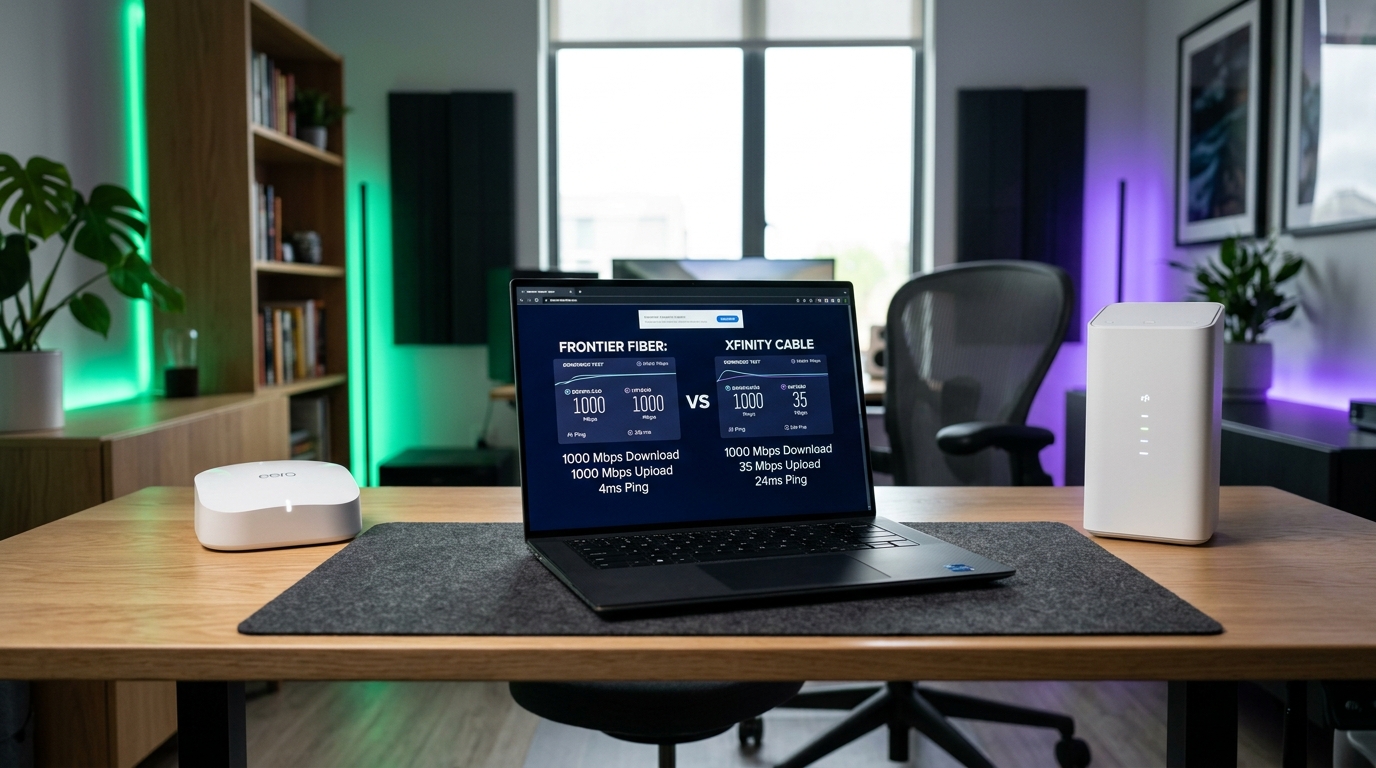
🚀 Upload Speeds: Frontier (1000 Mbps) vs Xfinity (35 Mbps)
📞 Check Frontier Availability: (888) 217-6472
Frontier Fiber vs. Xfinity Cable: Head-to-Head Comparison (2026)
Compare network technology, speeds, fees, contracts, and equipment side-by-side:
| Feature | Frontier Fiber (Winner) | Xfinity (Comcast) |
|---|---|---|
| Network Technology | 100% Pure Fiber (FTTH) | Hybrid Fiber-Coaxial (Cable) |
| 1 Gig Upload Speed | 1,000 Mbps (Symmetrical) | 35 Mbps (Throttled Cable) |
| Monthly Data Caps | Zero Caps (100% Unlimited) | 1.2 TB Cap ($10/50GB penalty) |
| Annual Contracts | None (Month-to-Month) | 1–2 Year Contracts Required |
| Included Wi-Fi Hardware | Amazon eero Pro 6E / Wi-Fi 7 (Free) | xFi Gateway ($15/mo rental fee) |
| 2nd-Year Price Hikes | Transparent / Price Locks | Price jumps $25–$40/mo |
| Max Multi-Gig Tier | Up to 7,000 Mbps (7 Gig) | Up to 2,000 Mbps (Cable) |
| Check Service & Order | 📞 Call Frontier: (888) 217-6472 |
Check Cable Availability |
If you live in a market where both Frontier and Xfinity (Comcast) overlap, you are looking at the classic battle of modern infrastructure. You are not just choosing between two brands; you are choosing between two entirely different networking technologies.
Xfinity operates a massive Hybrid Fiber-Coaxial (HFC) network. They use copper TV wires to deliver high download speeds to millions of homes. Frontier, on the other hand, is aggressively expanding its state-of-the-art 100% Fiber-Optic network, running glass strands directly into your living room.
While Xfinity has massive brand recognition, Frontier’s new fiber technology fundamentally changes the math on performance and hidden fees. Here is our definitive 2026 breakdown of why one provider holds a massive technological advantage over the other.
1. Speed & Reliability (Winner: Frontier Fiber)
When comparing the advertised "1 Gig" plans for both companies, the download speeds look identical. However, the upload speeds expose the fatal flaw in Xfinity's network.
The Xfinity Bottleneck (Asymmetrical Speeds)
Because Xfinity relies on aging coaxial cable lines, its network cannot handle massive amounts of two-way traffic. While Xfinity will gladly sell you 1,000 Mbps download speeds, your upload speed is frequently throttled to just 35 Mbps.
- The Problem: If you work from home, upload large video files, or stream on Twitch, your connection will bottleneck. Furthermore, Xfinity shares your local bandwidth node with your entire neighborhood. When everyone logs on at 7:00 PM, your latency spikes and your speeds drop.
Frontier’s Symmetrical Fiber Advantage
Frontier Fiber uses light to transmit data, providing Symmetrical Speeds.
- If you pay for Frontier’s 1 Gig plan, you get 1,000 Mbps Download AND 1,000 Mbps Upload. Because the fiber line is dedicated directly to your house, you are completely immune to evening neighborhood congestion. For hardcore gamers, remote workers, and smart-home enthusiasts, Frontier Fiber mathematically destroys Xfinity’s cable connection.
2. Data Caps & Overage Penalties (Winner: Frontier)
This is where the monthly bills start to diverge drastically.
Xfinity’s 1.2 TB Data Cap
In the vast majority of their service areas (outside of the Northeast), Xfinity enforces a strict 1.2 Terabyte (TB) data cap.
If your family watches 4K Netflix, downloads modern video games (which frequently exceed 100GB each), or runs 24/7 security cameras, you will blow past this limit. When you do, Xfinity charges you $10 for every 50GB you go over (up to a $100 penalty per month). To remove this limit, Xfinity forces you to pay an extra $30/mo for unlimited data (or $25/mo with an xFi Complete rental).
Frontier’s Unlimited Freedom
Frontier has zero data caps.
- Whether you use 500 GB or 5,000 GB in a month, your bill never changes. You never have to log into an app to check a "data meter" or worry about surprise overage fees.
3. Pricing & 2nd-Year Hikes (Winner: Frontier)
Both companies offer aggressive promotional pricing (often starting around $44.99 to $55/mo), but you have to read the fine print to see what happens in Year Two.
Xfinity’s Price Spikes & Contracts
Xfinity is notorious for introductory pricing that skyrockets after the first 12 to 24 months. A plan that starts at $50/mo can easily jump to $80 or $90/mo once the introductory discount expires. Additionally, Xfinity often requires a 1-year or 2-year Term Agreement to secure their lowest rates, meaning you will face an Early Termination Fee (ETF) if you cancel early.
Frontier’s Transparent Pricing
Frontier has actively moved away from the confusing cable TV pricing model.
- No Annual Contracts: You pay month-to-month and can cancel anytime.
- Price Guarantees: Frontier frequently offers multi-year price locks on its fiber plans, meaning the price you sign up for stays identical for years.
- Free Premium Wi-Fi: On most Fiber tiers, Frontier includes an ultra-premium Amazon eero Pro 6E mesh router for free, whereas Xfinity charges you to rent their "xFi Gateway."
The Final Verdict
If you have the option between the two, this is not a difficult choice. Frontier Fiber wins in a landslide.
Why You Should Choose Frontier:
If Frontier has laid fiber-optic cables on your street, you should sign up immediately. You get symmetrical upload speeds, zero data caps, a free premium mesh router, and no annual contracts. It is a vastly superior technology to traditional cable.
When to Choose Xfinity:
You should only choose Xfinity if Frontier Fiber has not reached your neighborhood yet (meaning Frontier only offers their legacy copper DSL service). If you are stuck choosing between Frontier DSL and Xfinity Cable, Xfinity is the better choice for high download speeds—just be prepared to manage their 1.2 TB data cap.