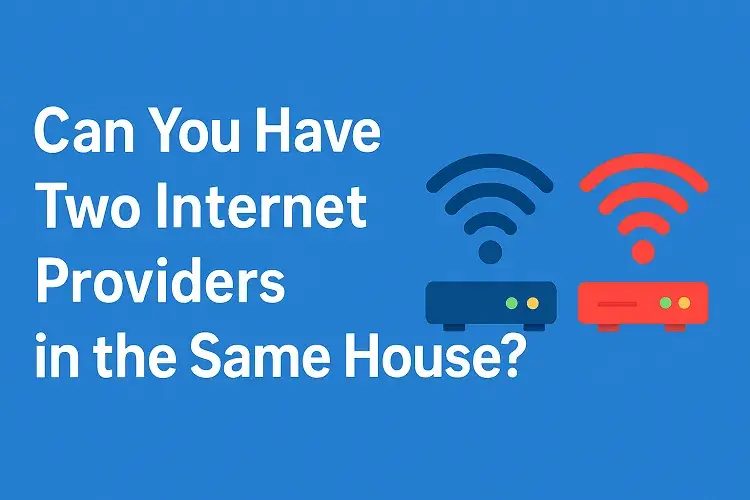
Yes, it is entirely possible to have two internet providers in the same house, provided they utilize different connection types, such as fiber plus 5G home internet or cable plus satellite. This setup offers significant benefits like enhanced redundancy for uninterrupted service and improved overall network performance through traffic distribution.
-
🛠️ The Requirement: You must use two different types of infrastructure (e.g., Cable + Fiber or Fiber + 5G) to ensure they don’t share the same physical wiring.
-
🔄 The Secret Sauce: Use a Dual-WAN Router (like the TP-Link ER605). This device connects both modems and automatically switches your connection in milliseconds if one provider fails.
-
🏆 The Pro Combo: Fiber + 5G Home Internet. This pair is the most resilient because 5G is wireless—if a construction crew accidentally cuts your underground fiber line, your 5G backup stays online.
-
📈 The Result: Total redundancy. Your Zoom calls, live streams, and trades won’t drop even if one ISP has a massive regional outage.
Yes, you can have two internet providers in the same house, as long as different connection types like cable, fiber, or DSL are available in your area. This setup provides redundancy, better performance, and flexibility for multi-user households.
Why Two Providers Work in One Home
Multiple internet service providers (ISPs) can coexist in a single residence because they typically use distinct infrastructure—cable relies on coaxial lines, DSL on phone lines, and fiber on dedicated optic cables. This avoids conflicts, allowing simultaneous service without shared wiring issues. Providers rarely block competitors outright, though exclusive contracts in some neighborhoods (like apartment complexes) may limit options—check local availability first. Technically, homes connect to the global internet backbone via tier-1 networks, and ISPs handle the last-mile delivery independently, making dual setups straightforward for most urban or suburban areas.
Key Benefits of Two Internet Providers in the Same House
Redundancy tops the list: if one ISP experiences outages—common during maintenance or storms—you switch seamlessly to the backup, ensuring uptime for work, streaming, or gaming. Load balancing distributes devices across networks, preventing slowdowns from heavy traffic; assign gaming consoles or 4K streaming to one while work laptops use the other. In shared homes, it splits bills fairly—roommates pay their own plans—and supports diverse needs, like high-speed fiber for professionals and budget DSL for casual use.
-
Stability during disruptions: Automatic failover via multi-WAN routers detects issues and reroutes traffic in seconds.
-
Faster overall speeds: Reduces congestion; households with 10+ devices see noticeable gains.
-
Cost sharing: Ideal for roommates or families, with potential tax deductions if one line is business-exclusive.
-
Smart home optimization: Dedicate IoT devices (cameras, thermostats) to a secondary, low-bandwidth connection.
The 2026 Setup: Fiber + 5G Wireless Backup
While traditional redundancy relied on two wired lines (like Cable + DSL), the modern standard for 2026 is Fiber paired with 5G Home Internet. This “Hybrid” setup offers a level of protection that two wired connections simply cannot match.
-
Physical Redundancy: If a neighbor’s construction crew accidentally cuts the underground fiber line to your house, a second wired connection (like cable) is often damaged as well because they usually run through the same conduit. 5G travels through the air, meaning it remains 100% unaffected by local line cuts.
-
Plug-and-Play Installation: Unlike adding a second wired ISP, adding 5G (from providers like T-Mobile or Verizon) doesn’t require a technician visit or new holes drilled in your walls. You simply plug the 5G gateway into a power outlet and sync it to your Dual-WAN router.
-
Cost-Effective “Insurance”: 5G Home Internet plans often start at $35–$50/mo when bundled with a mobile plan. For remote professionals, this is a low-cost insurance policy against a lost day of wages due to an internet outage.
-
The “Travel” Perk: Because 5G gateways are portable, you can unplug your backup ISP and take it with you on vacation or to a secondary location, a benefit you’ll never get with a second wired line.
Potential Drawbacks to Consider
Higher monthly bills add up—expect $100-200 total for two mid-tier plans versus $50-100 for one. Installation involves coordinating two providers, possibly drilling separate lines or mounting extra modems/routers, leading to clutter and minor signal interference risks. Not all areas support variety; rural spots might limit you to one type, like satellite only. Management requires tech-savvy: configure separate WiFi SSIDs or a unified network with VLANs to avoid overlap.
| Aspect | Single Provider | Dual Providers |
|---|---|---|
| Cost | Lower ($50-100/mo) | Higher ($100-200/mo) |
| Reliability | Vulnerable to outages | Redundant failover |
| Speed Under Load | Drops with many devices | Balanced across networks |
| Setup Complexity | Simple | Requires a multi-WAN router |
| Best For | Light use | Heavy/multi-user homes |
Step-by-Step Setup Guide
Start by researching local ISPs via tools like CompareInternetHub or FCC maps to confirm dual availability (e.g., cable + fiber in metros like Dallas or Los Angeles). Contact providers separately—Spectrum for cable, AT&T for fiber—requesting service at your address; mention existing setups to avoid conflicts. Install modems in central spots, then connect to a dual-WAN router like TP-Link ER605 ($60) or Ubiquiti Dream Machine for automatic failover and load balancing.
-
Verify compatibility: Ensure different connection types (no two cables).
-
Sign up independently: Get separate accounts and equipment rentals.
-
Position hardware: Modems near entry points; routers in high-coverage areas.
-
Configure network: Set unique SSIDs (e.g., “HomeFast” and “HomeBackup”); enable failover in router settings.
-
Test thoroughly: Run internet speed tests (Speedtest.net) and simulate outages by unplugging one modem.
-
Optimize devices: Use apps like Fing to assign traffic (e.g., work PC to primary).
Advanced users can bond connections via Speedify software for combined speeds, though it adds $10/mo.
Maximizing Value and Alternatives
Shop bundles or promos—new customers often get 6-12 months discounted. Invest in mesh WiFi (e.g., Eero Pro) to extend both networks house-wide without dead zones. If dual ISPs aren’t feasible, mimic benefits with one high-tier plan + two routers for VLAN isolation, boosting device capacity without speed loss.
Monitor via router apps or Google Analytics for traffic patterns, optimizing like PPC bids. Environmentally, dual setups encourage efficient plans over overkill single subscriptions. Ultimately, for reliability-focused users, two providers transform homes into robust networks rivaling offices.
Conclusion
Having two internet providers is feasible and practical, offering significant advantages in reliability and overall network performance. While it necessitates specific hardware and careful cost/configuration, benefits for remote workers, smart homes, and busy households often justify the investment, ensuring a successful and resilient home network.
FAQ
Can I have two different internet providers in the same house legally?
Yes, it is entirely legal to have two different internet providers in the same house. Federal Communications Commission (FCC) regulations generally prevent landlords from entering into exclusive agreements with a single ISP, ensuring consumer choice. However, physical installation of a second line in a rental property typically requires your landlord’s written consent due to potential alterations to the building’s structure.
What are the main benefits of having two internet connections at home?
The main benefits of having two internet connections are enhanced reliability and improved performance. Reliability is achieved through failover, where a secondary connection automatically takes over if the primary fails, ensuring continuous internet access. Performance is improved through load balancing, which distributes traffic across both connections, preventing congestion and providing smoother experiences for multiple users or high-bandwidth activities.
What equipment do I need for a dual internet setup?
The most essential piece of equipment for a dual internet setup is a dual-WAN (Wide Area Network) capable router. This router features at least two WAN input ports to connect to each ISP’s modem. You will also need a separate modem (or ONT) for each internet service, along with sufficient Ethernet cables. An Uninterruptible Power Supply (UPS) for your network gear is also recommended for brief power outages.
How much does it cost to have two internet providers in one house?
The combined monthly cost for two internet providers typically ranges from $65 to $200 or more, often pairing a primary high-speed plan with a lower-cost backup (as of October 2026). Additionally, you’ll incur one-time costs, including the dual-WAN router (typically $99 to $500+), and potential installation fees (ranging from $0 for self-install to over $100 per provider for professional setup).
Will a dual internet setup double my internet speed for downloads?
No, a dual internet setup with load balancing will not double your internet speed for a single download or stream. Load balancing distributes individual network sessions across available connections, improving aggregate capacity for multiple simultaneous users or diverse applications. However, a single download will still be limited by the maximum speed of the faster individual internet connection it’s routed through.
How do I configure a dual-WAN router for failover?
To configure a dual-WAN router for failover, first connect both modems to the router’s designated WAN ports. Access the router’s web interface and navigate to the “Dual WAN” or “Failover” settings. Designate your primary and secondary WAN connections. Set up WAN health monitoring (SLA Monitoring) with ping targets (e.g., 8.8.8.8), latency thresholds, and packet loss limits to detect outages and trigger automatic switching to the backup connection.
Updated on: October 8, 2026