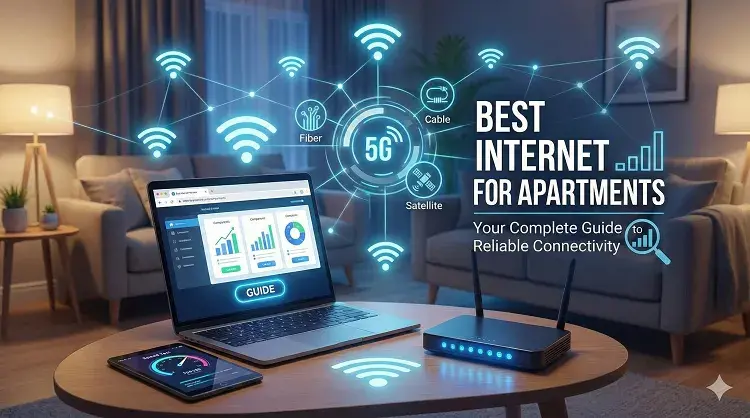
The best internet providers for apartments in 2026 are AT&T Fiber (reliability), Spectrum (availability), and T-Mobile 5G (no-contract/easy setup). For the lowest cost, Frontier Fiber starts at $29.99/mo with symmetrical speeds.
Understanding Your Internet Speed Needs
Before comparing providers, it’s crucial to determine how much internet speed your apartment actually needs. The answer depends on several factors, including household size, usage patterns, and the number of devices you’ll connect simultaneously.
For a single person living alone with light to moderate usage (browsing, email, and occasional streaming), 100 Mbps download speed is typically sufficient. This speed handles standard-definition video streaming on one or two devices simultaneously without buffering issues. However, if you’re planning to work from home, attend video conferences, or game online, you’ll want to ensure your connection can handle these bandwidth-intensive activities.
Netflix recommends a minimum of 25 Mbps for 4K streaming, while basic HD streaming requires only 5-10 Mbps. For households with multiple people using the internet simultaneously, the FCC defines broadband as 100 Mbps download and 20 Mbps upload speeds, which they consider the baseline for modern internet usage. Families with three to four members who enjoy mixed 4K and HD streaming should consider 200-300 Mbps, which provides comfortable bandwidth for simultaneous streaming, video conferencing, and gaming without noticeable slowdowns.
Peak hour congestion is a particularly important consideration for apartment dwellers. Between 7 PM and 11 PM, shared infrastructure in apartment complexes experiences significant bandwidth bottlenecks. During these times, your advertised speeds may drop substantially as multiple neighbors simultaneously stream video, work from home, and game online. This is especially problematic with cable internet, where bandwidth is shared among all users connected to the same node.
Internet Connection Types Available for Apartments
Modern apartments have access to several internet connection technologies, each with distinct advantages and limitations.
Cable Internet remains the most widely available option in urban areas, covering approximately 97% of urban neighborhoods. Major providers like Spectrum, Xfinity, Cox, and Mediacom deliver speeds ranging from 25 Mbps to 2,000 Mbps depending on your plan tier. Cable is generally affordable, with introductory rates starting around $30-40 per month for 300-400 Mbps speeds. The primary drawback is that cable uses shared infrastructure, meaning network congestion during peak hours is inevitable. A single cable node typically serves dozens of households, so your actual speeds may fluctuate based on neighborhood demand.
Fiber-optic internet ranks as the second-most available connection type in urban areas, with nearly 50% coverage in cities. Providers like AT&T Fiber, Verizon Fios, Google Fiber, Frontier, and CenturyLink offer speeds between 50 Mbps and 8,000 Mbps with pricing from $20-$300 monthly. Fiber delivers superior performance characteristics: symmetrical upload and download speeds (critical for video conferencing), consistent speeds regardless of network congestion, and future-proof infrastructure. However, fiber availability depends on building infrastructure—your apartment must have fiber lines already installed or the landlord must permit installation.
5G Home Internet from T-Mobile and Verizon represents the newest competitive option, requiring no installation and no long-term contracts. T-Mobile 5G Home Internet delivers impressive performance with median download speeds of 238 Mbps on 5G networks, compared to 50 Mbps for AT&T and Verizon on their respective 5G networks. Setup is remarkably simple—you place the gateway device near a window, and service activates in approximately 15 minutes. Pricing is competitive at $50-70 monthly with unlimited data. The limitation is that 5G performance varies significantly by location and building construction, with concrete walls potentially degrading signal quality.
Fixed Wireless Access (FWA) from providers like Starry and Google Fiber’s Webpass utilizes advanced wireless technology to deliver speeds between 50-1,000 Mbps for $30-100 monthly. This technology is particularly valuable for apartments where traditional infrastructure deployment isn’t feasible.
Top Internet Providers for Apartment Living in 2026
Based on current performance metrics and customer satisfaction data, certain providers consistently deliver better value for apartment residents.
Google Fiber (GFiber) dominates quality rankings, earning the top cumulative broadband ISP index score of 24.8 out of 40. It excels in pricing, customer satisfaction, and performance. Google Fiber offers speeds up to 8 Gbps with symmetrical upload and download speeds. The Core 1 Gig plan costs just $70 monthly, including installation, Wi-Fi equipment, a mesh-ready router, and unlimited data with no extra fees. The significant limitation is availability—Google Fiber operates only in 19 states with limited metropolitan coverage, including Austin, Houston, San Antonio, Oakland, San Francisco, and select California locations.
AT&T Fiber 300 emerges as the best balanced option for most apartment dwellers. This plan delivers 300 Mbps over fiber-optic infrastructure at $55 per month, provides unlimited data, includes free equipment rental, comes without contracts, and features preset price increases that remain transparent upfront. AT&T has invested significantly in fiber expansion and makes dedicated efforts to serve apartment buildings. The plan is affordable, offers excellent speed for streaming and working from home, and removes the typical cable provider pain point of post-promotional price shock.
Spectrum ranks as the best overall cable provider, winning PCMag’s divisional award as the best ISP in multiple regions including the Midwest. Introductory plans start at $30 per month for 300 Mbps speeds, feature unlimited data, and include free modem rental—eliminating the $10-20 monthly rental fees other cable companies charge. Spectrum provides consistent performance across its service area. The trade-off is that post-introductory pricing increases significantly, and fiber availability remains limited.
Frontier Fiber offers exceptional value, delivering 200 Mbps symmetrical speeds for just $30 monthly, with an option to upgrade to 500 Mbps for $40 monthly. Frontier emphasizes clear pricing without hidden fees, includes unlimited data and free equipment, and doesn’t require long-term contracts. This makes Frontier particularly attractive for apartment residents seeking fiber performance at cable-level pricing.
Verizon Fios Home Internet provides excellent reliability and performance in service areas, which currently encompass Northeast states, parts of California, and Washington. Plans start at $34.99 monthly with a qualifying mobile plan and range up to 2,300 Mbps for premium tiers. Verizon distinguishes itself through exceptional customer perks, including free equipment, periodic gift card promotions, and stable pricing after promotional periods.
T-Mobile 5G Home Internet deserves serious consideration for apartment dwellers, particularly those frustrated by cable provider behavior. At $50 monthly with unlimited data and no contracts, this wireless service requires zero installation appointments and no building permissions. Performance is highly location-dependent, but urban and suburban apartments typically enjoy strong signal strength. T-Mobile 5G achieves median speeds of 238 Mbps, far exceeding AT&T and Verizon’s 5G speeds.
| Provider | Best For | Typical Speeds | Starting Price (Approx.) | Notable Features |
|---|---|---|---|---|
| Google Fiber | Best overall performance | Up to 8 Gbps | ~$70 /mo (1 Gb plan) | Symmetrical speeds; excellent reliability; includes hardware |
| AT&T Fiber | Balanced choice for most apartments | ~300 Mbps (plans up to multi-Gbps) | ~$55 /mo | Unlimited data; free equipment; transparent pricing |
| Spectrum (Cable) | Best cable option | 300 Mbps (intro tiers) | ~$30 /mo | Widely available cable service; unlimited data |
| Frontier Fiber | Value fiber option | 200–500 Mbps | ~$30–40 /mo | Symmetrical speeds; no contract |
| Verizon Fios | Reliable fiber | 300–2300 Mbps | ~$34.99 /mo (promo) | Strong customer perks & stable pricing |
| T-Mobile 5G Home Internet | Wireless, easy setup | ~238 Mbps (median) | ~$50–70 /mo | No installation; no contracts |
Special Considerations for Apartment Residents
Building Infrastructure and Restrictions
Your apartment’s specific situation may limit your provider choices. Many apartment buildings have “bulk billing” arrangements where management negotiates with specific ISPs to receive discounted rates in exchange for exclusive service within the building. While these arrangements typically offer better prices (sometimes 50% lower than retail rates), they restrict your ability to choose alternative providers. The FCC previously proposed requiring opt-out provisions, but this proposal was withdrawn in 2025, meaning bulk billing arrangements remain largely unchallenged.
If your building offers limited choices, it’s worth requesting landlord approval for an alternative service. Building owners can often accommodate fiber installation or fixed wireless solutions if enough residents express interest. Alternatively, 5G home internet from T-Mobile or Verizon may bypass traditional building infrastructure entirely.
WiFi Coverage and Performance
When you choose Wi-Fi for Apartment then Signal degradation represents a significant challenge in apartments. High-rise buildings feature thick concrete walls, steel studs, and numerous competing WiFi networks operating on the same frequency bands, creating interference and dead zones. Many apartment residents discover their advertised speeds don’t translate to usable performance throughout their units.
The solution is strategic WiFi infrastructure investment. A quality mesh WiFi system significantly improves coverage across apartments. WiFi 6 mesh systems like the Amazon eero 6 (starting around $100), TP-Link Deco XE5300 (mid-range at $200-250), or Netgear Orbi 770 (premium option at $300+) deliver superior coverage compared to standard routers. For apartments with internet speeds up to 500 Mbps, the eero 6 offers excellent value and covers typical apartment square footage (averaging under 800 sq ft) efficiently.
Placing your router centrally within your apartment maximizes coverage. For critical activities like video conferencing, gaming, or large file downloads, use an Ethernet connection directly to the modem or router rather than WiFi, which typically provides 20-30% lower speeds than wired connections.
Congestion During Peak Hours
Evening hours (7-11 PM) consistently show 20-50% speed reductions in apartment complexes due to network congestion. This is particularly problematic with cable internet, where shared bandwidth means everyone’s speeds suffer simultaneously. If your primary usage occurs during these peak windows, consider fiber-optic service, which dedicates bandwidth to your connection and maintains consistent speeds regardless of neighborhood demand.
Cost Analysis and Budget Planning
The average American household pays approximately $75.72 monthly for internet service, though monthly costs typically range between $60-90. Apartment dwellers can find quality service at lower tiers, while premium options require higher investment.
Budget-Conscious Apartments (single person or light usage, $30-50/month):
-
Spectrum Internet 300: $30/mo. for 300 Mbps
-
Xfinity Connect More: $30-40/mo. for 400 Mbps
-
Frontier Fiber 200: $30/mo. for 200 Mbps
-
T-Mobile 5G Home Internet: $50/mo. for 72-245 Mbps
Moderate Usage Apartments (2-3 people with streaming/gaming, $50-75/month):
-
AT&T Fiber 300: $55/mo. for 300 Mbps
-
Spectrum Internet Premier: $60/mo. for 500 Mbps
-
Verizon Fios 300: $50-70/mo. depending on promotions
-
Google Fiber 1 Gig: $70/mo. for 1,000 Mbps (where available)
High-Performance Apartments (4+ people, working from home, heavy streaming, $75+/month):
-
Google Fiber 3 Gig: $100/mo. for 3,000 Mbps
-
AT&T Fiber 500: $85-105/mo. for 500 Mbps
-
Verizon Fios Gigabit: $90-110/mo. for 1,000 Mbps
-
Spectrum Internet Gig: $110-130/mo. for 1,000 Mbps
Important pricing notes: Introductory rates shown above typically expire after 12-24 months, with standard rates increasing $25-40 monthly thereafter. Exceptions include Quantum Fiber (price lock guarantee), Frontier (published price increases with no surprises), and AT&T Fiber (transparent pricing structure without steep post-promotional increases).
Making Your Decision: Ask the Internet for an Apartment
Before committing to any provider, verify several critical details:
-
What connection types are available at your specific address?
Use provider availability checkers for your zip code and building address. Fiber availability often varies block-by-block within neighborhoods. -
Does your lease permit independent internet choice, or does bulk billing lock you into specific providers?
Review your lease or contact management to understand restrictions. -
What are the actual speeds other residents achieve during peak hours?
Ask neighbors about their experiences. Reddit communities and apartment review sites provide honest assessments of real-world performance. -
Are there contract requirements or early termination fees?
Most modern providers eliminate contracts, but verification prevents surprises. -
What equipment is included, and what are the rental fees?
Some providers include modem/router equipment free, while others charge $10-20 monthly for rentals. Purchasing your own equipment (typically $50-150) often saves money long-term. -
What is the cancellation process, and does the provider offer trial periods?
Knowing exit options matters, particularly with new technologies like 5G home internet, where performance varies by location.
Optimizing Your Apartment Internet Experience
Once you’ve selected a provider and established service, several steps optimize your internet performance:
Position your router centrally within your apartment rather than in a corner bedroom. Central placement distributes the WiFi signal more evenly throughout your space.
Use WiFi 6 technology whenever possible. This standard (802.11ax) delivers roughly 40% faster speeds than older WiFi 5 technology, handles more simultaneous device connections, and reduces interference in congested apartment environments.
Connect critical devices via Ethernet whenever feasible. Gaming consoles, smart TVs, and work-from-home computers perform noticeably better on wired connections compared to WiFi, particularly during peak congestion hours.
Schedule demanding tasks outside peak hours. Download large files, install software updates, and perform system backups during daytime hours or very late evening (after 11 PM) when neighborhood demand subsides.
Monitor your monthly usage against any data caps your provider enforces. Cox Communications, for example, allows 1.25 TB monthly with $10 charges per 50 GB overage, making overage monitoring essential. Most modern providers have eliminated or increased data caps substantially, but verification remains important.
Finding the Perfect Internet for Your Apartment
The best apartment internet service balances speed, reliability, affordability, and customer experience against your specific usage patterns and building infrastructure. For most apartments, the decision primarily involves choosing between cable (affordable, widely available, but congestion-prone) and fiber (premium performance with stable speeds but potentially limited availability).
Google Fiber represents the aspirational choice if available in your area, combining elite performance with transparent pricing. AT&T Fiber 300 emerges as the practical best option for most apartment dwellers, delivering balanced performance and reliability without high cost. Spectrum and Frontier provide excellent value for cable-based solutions, while T-Mobile 5G Home Internet offers innovative wireless alternatives, particularly suited to apartments where traditional infrastructure poses challenges.
FAQ
1. Can I get my own internet if my apartment provides a ‘Bulk’ plan?
Yes, in most cases you can still choose your own provider. Services like T-Mobile 5G or Verizon 5G Home Internet are great options because they don’t require building-wide wiring. However, keep in mind that you may still be required to pay the “bulk” fee that is already included in your rent or HOA dues.
2. What is the best internet for apartments with no contracts?
Spectrum, AT&T Fiber, and T-Mobile 5G Home Internet are the top choices for apartment dwellers who want to avoid long-term commitments. These providers offer month-to-month plans, which are perfect for renters who might need to move on short notice.
3. Why is my apartment’s internet slow during the evening?
This is usually caused by “network congestion.” In apartment complexes that use shared cable lines (like Spectrum or Xfinity), everyone using high bandwidth at the same time can slow down the local connection. Switching to a dedicated Fiber line (like AT&T or Frontier) can often solve this problem.
4. How much internet speed do I need for a 1-bedroom apartment?
For a single professional or a couple, a 300 Mbps plan is generally the “sweet spot.” It provides enough speed for 4K streaming, video calls, and gaming all at the same time without any annoying buffering.
5. Is 5G Home Internet good for high-rise apartments?
5G Home Internet can be an excellent alternative if your unit has a window with a clear line of sight to a cell tower. However, thick concrete walls or energy-efficient glass can sometimes weaken the signal. It’s always a good idea to test the service during the initial 15-day trial period to ensure it works in your specific unit.
Ready to Upgrade Your Apartment Internet Today?
Don’t settle for slow, unreliable internet that buffers during movie nights and drops calls during important video conferences. Our team specializes in matching apartment residents with internet solutions that deliver the speed, reliability, and value you deserve.
Call our internet specialists today to discuss your apartment’s specific situation, confirm provider availability at your address, and secure the best promotional rates before they expire. Our representatives can typically establish service within 24-48 hours, and we’ll help you understand all equipment fees, contract terms, and performance expectations upfront.
Apartment living shouldn’t mean compromising on connectivity. Let us help you find internet service that keeps you connected, entertained, and productive—all at a price that fits your budget. Whether you need fiber-optic performance, reliable cable service, or innovative 5G wireless solutions, our team has the expertise to guide your decision.
Call now for your free internet consultation and discover how much you could save on your monthly internet costs.
Updated on: March 21, 2026