Cable internet was the default choice for American households for nearly two decades — and for good reason. It was fast, relatively affordable, and widely available. But in 2026, more U.S. households are actively looking for alternatives than ever before.
The reasons are consistent: promotional prices that jump $20 to $40 after the first year, speed slowdowns during peak evening hours when the whole neighborhood is online simultaneously, upload speeds so slow they make video calls frustrating, and two-year contracts that make it painful to switch even when service underperforms.
Here is the critical reality: cable internet runs on a shared network. Every home on your street competes for the same bandwidth during busy hours. As streaming, remote work, and smart home device usage grow, the shared infrastructure increasingly shows its limits.
The good news for U.S. consumers in 2026 is that genuine alternatives now exist at every price point, in more locations than ever before. Whether you live in a major city, a mid-size suburb, or a rural community, at least one of the five alternatives below is likely available at your address — and may serve you significantly better than cable at a comparable or lower cost.
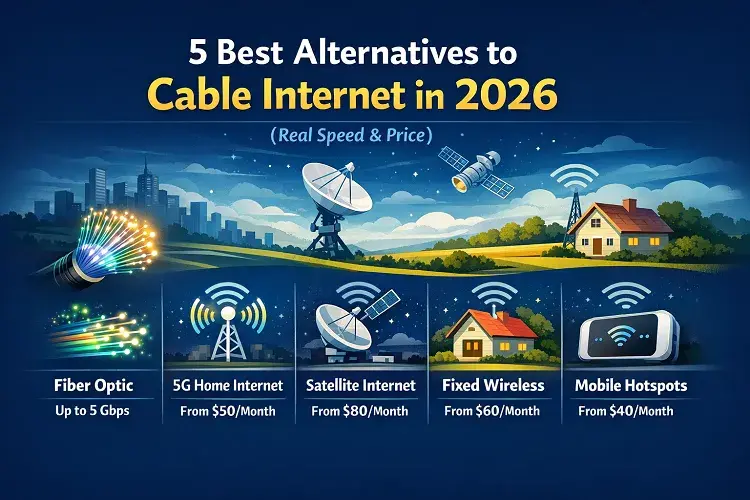
Quick Comparison: 5 Cable Internet Alternatives at a Glance
| Alternative | Typical Speed | Starting Price | Best For | Availability |
|---|---|---|---|---|
| Fiber Internet | 300 Mbps – 10 Gbps | $45 – $80/mo | Speed, reliability, and remote work | ~50% of U.S. homes |
| DSL Internet | 5 – 100 Mbps | $30 – $60/mo | Light users, rural areas | ~90% of U.S. homes |
| Satellite Internet | 50 – 350 Mbps | $50 – $120/mo | Rural, remote areas | Nearly 100% of the U.S. |
| Fixed Wireless (5G Home) | 100 – 500 Mbps | $40 – $70/mo | Renters, no-contract users | ~60–70% of U.S. homes |
| Mobile Broadband | 25 – 300 Mbps | $30 – $60/mo | Mobile users, temporary needs | ~95% of U.S. (4G/5G) |
Alternative 1: Fiber Internet — The Strongest Cable Replacement
Fiber optic internet is the clearest upgrade from cable available in 2026, and it is no longer a luxury reserved for tech-forward cities. As of early 2026, fiber is accessible to approximately 50% of U.S. households — up from just 30% three years ago — with major providers including AT&T Fiber, Frontier Fiber, Verizon Fios, and hundreds of local and municipal fiber networks expanding coverage rapidly.
The core advantage fiber holds over cable comes down to two things: symmetrical speeds and dedicated infrastructure. Cable networks are shared — your neighborhood’s households all pull from the same bandwidth pool. Fiber runs a dedicated line directly to your home, so your neighbor’s streaming habits have zero impact on your connection speed. And unlike cable’s dramatically slower upload speeds (typically 10 to 35 Mbps), fiber delivers equal upload and download speeds — 500 Mbps up and 500 Mbps down on a 500 Mbps plan.
In real-world terms, this matters enormously if you work from home and need consistent video call quality, if you game online and need low latency, or if your household streams on multiple devices simultaneously.
Pricing in 2026 starts at approximately $45 to $55 per month for 300 Mbps fiber plans from AT&T, Frontier, and Quantum Fiber, with gigabit (1,000 Mbps) plans available from most providers between $65 and $80 per month. Most major fiber providers now offer no-contract, month-to-month terms with no data caps and no equipment rental fees.
Who fiber is best for: Remote workers, gamers, large households, anyone currently paying over $70/month for cable and receiving inconsistent performance.
Alternative 2: DSL Internet — The Wide-Reach Budget Option
DSL (Digital Subscriber Line) uses the existing telephone copper wire infrastructure to deliver internet service, which is why it reaches approximately 90% of U.S. households — far more than cable or fiber. In areas where cable has not been deployed, or fiber is still years away, DSL is often the only wired alternative available.
The honest trade-off with DSL is speed. Most DSL connections in 2026 deliver between 10 and 100 Mbps download, with upload speeds rarely exceeding 10 to 20 Mbps. Performance also degrades with distance — the farther your home sits from the telephone provider’s nearest network hub, the slower your actual speeds. Advertised speeds and real-world speeds can diverge significantly with DSL in ways that fiber and cable do not experience to the same degree.
That said, for households with 1 to 2 users doing light streaming, web browsing, email, and video calls, DSL plans starting at $30 to $50 per month from providers like Brightspeed, Windstream, and CenturyLink deliver adequate performance at a price point no cable company can match.
Who DSL is best for: Rural households, light internet users, budget-first households with no fiber or cable access, and seniors on fixed incomes.
Alternative 3: Satellite Internet — True Nationwide Coverage
Satellite internet is the only technology that delivers broadband service to virtually every address in the United States, including remote rural properties, mountain communities, and locations where no cable or fiber infrastructure will ever realistically be deployed.
The satellite internet landscape changed dramatically when Starlink (SpaceX’s low-earth orbit satellite network) began widespread U.S. service. Unlike traditional geostationary satellites that orbit 22,000 miles above Earth and produce latency of 500 milliseconds or more, Starlink’s LEO satellites orbit at approximately 340 miles, delivering latency of 25 to 60 milliseconds — low enough for video calls, streaming, and even casual online gaming.
Starlink’s residential service is priced at $120 per month in 2026, with download speeds of 100 to 350 Mbps depending on location and satellite congestion. Traditional satellite providers, including HughesNet and Viasat, remain available at lower monthly prices ($50 to $80/month) but with more significant speed and latency limitations. No annual contract is required for Starlink; standard plans are month-to-month.
The primary limitations of satellite internet remain weather sensitivity (heavy rain and snow can briefly impact signal quality), the upfront equipment cost ($349 for the Starlink dish and router), and higher monthly pricing compared to wired alternatives where those are available.
Which satellite is best for: Rural and remote households, properties outside cable and fiber service zones, RV users, and backup internet connections for businesses in underserved areas.
Alternative 4: Fixed Wireless (5G Home Internet) — The No-Install Revolution
Fixed wireless internet — delivered primarily by T-Mobile Home Internet and Verizon 5G Home Internet in 2026 — has become the fastest-growing internet category in the U.S. for a straightforward reason: it requires no technician visit, no drilling, no coaxial cable running through your walls, and no annual contract.
The service works by placing a small wireless gateway unit in your home — near a window for best signal — that connects to a nearby 5G cellular tower and broadcasts Wi-Fi throughout your home, just like any router. Setup takes under 15 minutes, and equipment arrives by mail.
T-Mobile Home Internet covers approximately 60 to 70% of U.S. homes at $50 per month with no data caps and no contracts. Existing T-Mobile mobile customers pay $40 per month with a mobile bundle discount. Real-world download speeds range from 100 to 415 Mbps, depending on your proximity to a tower and local network congestion. Verizon 5G Home Internet offers similar terms with coverage concentrated in suburban and urban markets.
The limitation compared to fiber is consistency — fixed wireless speeds can vary during peak hours depending on tower congestion, and latency averages 30 to 60 milliseconds compared to fiber’s 5 to 15 milliseconds. It is not the ideal choice for competitive gaming or households with very heavy upload demands, but for the majority of American households, it delivers more than sufficient performance.
Who fixed wireless is best for: Renters, frequent movers, households avoiding installation appointments, and anyone who wants a genuinely no-contract internet plan.
Alternative 5: Mobile Broadband — Internet That Goes Where You Go
Mobile broadband uses the same 4G LTE and 5G cellular networks that power your smartphone to deliver internet access through a portable hotspot device or your phone’s built-in hotspot feature. With national carriers like T-Mobile, AT&T, and Verizon covering 95% or more of the U.S. population, mobile broadband has the second-widest reach of any internet technology after satellite.
Dedicated mobile hotspot plans in 2026 start at approximately $30 to $35 per month for 15 to 30 GB of high-speed data, scaling to $60 per month for unlimited data plans with 5G access. Real-world speeds on 5G mobile broadband range from 50 to 300 Mbps in covered areas, though coverage quality varies significantly between rural highways and dense urban centers.
The key distinction between mobile broadband and fixed wireless is portability. Mobile broadband travels with you. Fixed wireless stays at your home address. For remote workers who split time between a home office and travel, mobile broadband paired with a fixed wireless home connection is an increasingly popular combination that eliminates reliance on cable.
The limitations are data deprioritization (speeds slow during network congestion after monthly thresholds are reached) and higher cost-per-gigabyte compared to unlimited wired plans.
Who mobile broadband is best for: Travelers, remote workers on the road, students, temporary housing situations, households using it as a secondary connection alongside another primary service.
How to Choose the Right Cable Alternative for Your Home?
Choosing the right cable alternative depends on three variables specific to your household: your location, your usage patterns, and your budget. Start by checking which of the five options above are available at your exact address — coverage maps are approximate, and address-level availability checks on provider websites are the only reliable confirmation.
If fiber is available at your address, it is the recommended upgrade for the majority of households in 2026 — better speeds, better reliability, lower long-term cost, and no shared-network congestion. If fiber is not yet available, fixed wireless 5G is the strongest no-contract, no-install alternative for suburban and urban households. For rural addresses, satellite internet — particularly Starlink — delivers the most capable wireless broadband available outside wired infrastructure zones.
The cable internet era is not over, but it is no longer the only viable choice. In 2026, Americans have more real, competitive broadband options than at any previous point — and the gap in quality between the best cable alternatives and cable itself continues to widen.
Frequently Asked Questions: Alternatives to Cable Internet
1. What is the best alternative to cable internet in 2026?
Fiber internet is the best overall alternative for U.S. households with access, offering faster speeds, symmetrical upload and download performance, and lower long-term costs than cable. For households without fiber access, 5G fixed wireless from T-Mobile or Verizon is the strongest cable replacement available in 2026.
2. Can I get home internet without cable?
Yes. Fiber, DSL, satellite, fixed wireless 5G, and mobile broadband all deliver home internet service without requiring a cable television connection or coaxial cable infrastructure. Most of these options are available in major U.S. markets and many rural areas.
3. What is the cheapest alternative to cable internet?
DSL plans from providers like Brightspeed and Windstream start as low as $30 per month, making them the most affordable cable alternative. For wireless options, T-Mobile Home Internet at $40 per month (with a mobile bundle) is the strongest value no-contract alternative in 2026.
4. Is 5G home internet better than cable?
For many households, yes. T-Mobile and Verizon 5G Home Internet deliver comparable speeds to cable entry plans with no contracts, no equipment fees, and no shared-network congestion. However, fiber internet outperforms both cable and 5G home internet for upload speeds, latency, and peak-hour consistency.
5. Does satellite internet work for working from home?
Starlink satellite internet is capable of supporting remote work in 2026 with download speeds of 100 to 350 Mbps and latency of 25 to 60 milliseconds — adequate for video conferencing platforms like Zoom and Microsoft Teams. Traditional geostationary satellite providers with 500ms+ latency are not recommended for video-call-heavy remote work.