2026 Showdown Verdict
AT&T Fiber vs. Xfinity: Which Wins in 2026?
Xfinity: 3.9 / 5 ⭐
The Bottom Line: If AT&T Fiber is available at your address, it is the decisive winner over Xfinity Cable. AT&T provides 100% symmetrical upload/download speeds (up to 5,000 Mbps), zero data caps, included Wi-Fi 6 hardware ($0/mo), and straightforward flat-rate pricing with no annual contracts. In contrast, Xfinity relies on hybrid copper coaxial lines with severely throttled upload speeds (only 20–35 Mbps on gigabit plans), enforces a 1.2 TB monthly data limit in most states, charges \$15/mo for gateway rentals, and hits subscribers with steep $20–$40/mo price hikes after month 12.
✔ Why AT&T Fiber Wins
- Equal upload & download speeds up to 5,000 Mbps
- Unlimited data included on all fiber plans
- No router rental fee (BGW320 included free)
- No contract and no 2nd-year promotional rate hikes
✖ Where Xfinity Falls Short
- Slow upload speeds (often capped at 20–35 Mbps)
- 1.2 TB data cap (\$10 per 50 GB overage charge)
- $15/month extra charge for xFi Gateway router
- Prices increase by \$20–\$40/month after year one
If you live in the Midwest or the East Coast, the decision between AT&T and Xfinity (Comcast) is one of the most heavily debated internet choices you will make.
While their marketing campaigns look very similar, the actual infrastructure they use to deliver the internet to your house belongs to two completely different eras of technology. Xfinity relies on a legacy Cable network that has been continually upgraded, while AT&T operates a massive, newly constructed Fiber-Optic network.
If you are a remote worker struggling with buffering Zoom calls, or a heavy downloader tired of paying overage fees, you must understand the technical differences between these two networks before you sign a contract.
Here is the complete Compare Internet Hub engineering breakdown of AT&T vs. Xfinity for 2026, and why one provider holds a massive technological advantage.
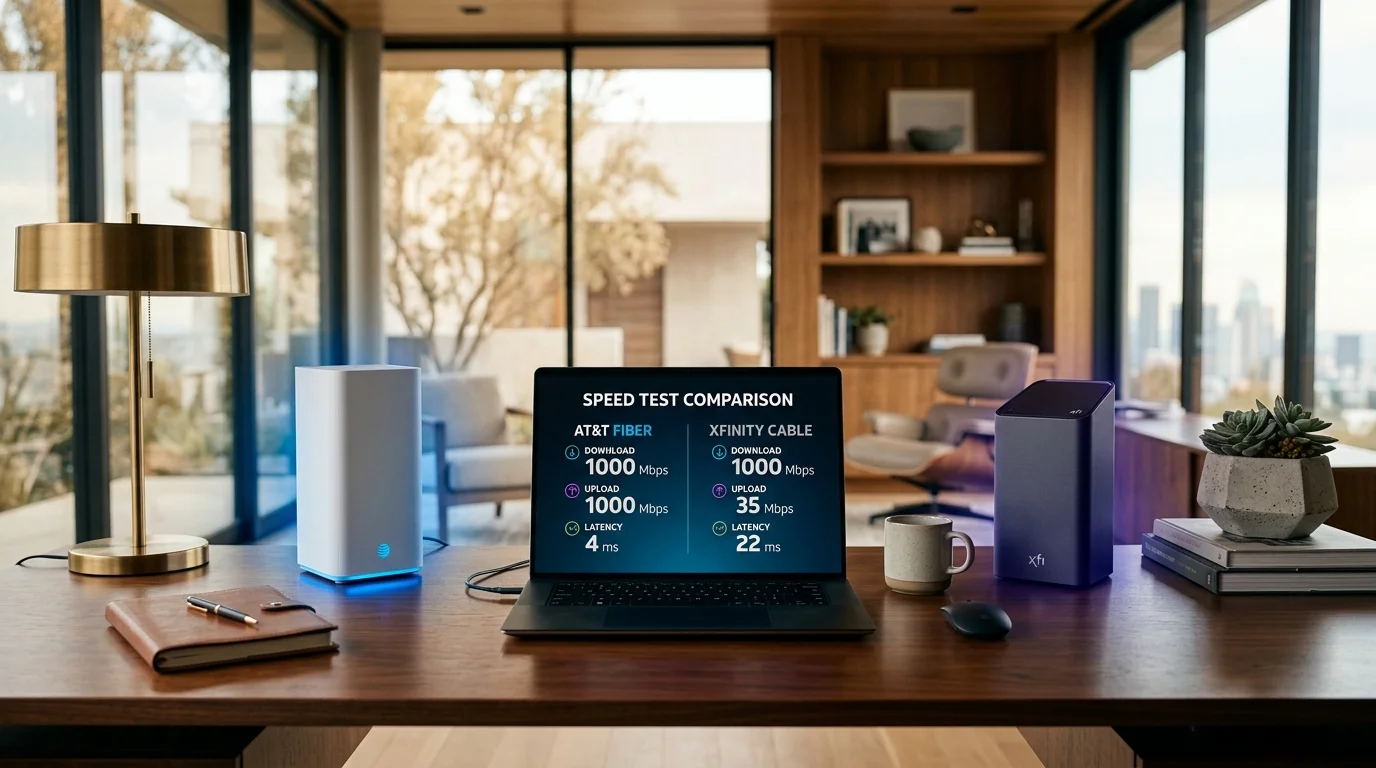
1. The Technology: DOCSIS 3.1 vs. Pure Fiber (FTTH)
AT&T Fiber vs. Xfinity Cable: Speed Tiers & Monthly Pricing
2026 Plan Matchup
| Speed Tier | AT&T Fiber (FTTH) | Xfinity Cable (HFC) | Upload Speeds | Order Hotline |
|---|---|---|---|---|
| 300 Mbps Tier Everyday Streaming & WFH |
$55.00/mo No 2nd-year hike |
$35.00 – $55.00/mo Jumps after promo |
AT&T: 300 Mbps Xfinity: 20 Mbps |
Call AT&T |
| 500 Mbps Tier Multi-Device Homes |
$65.00/mo No 2nd-year hike |
$55.00 – $70.00/mo Jumps after promo |
AT&T: 500 Mbps Xfinity: 20 Mbps |
Call AT&T |
| 1 Gig (1,000 Mbps) ⭐ Best Overall Value |
$80.00/mo Unlimited Data • $0 Router |
$65.00 – $85.00/mo +$15/mo router + Cap |
AT&T: 1,000 Mbps (Symmetrical) Xfinity: 35 Mbps |
Order AT&T |
| 1.2G / 2 Gig Tier Creators & Gamers |
$145.00/mo (2 Gig) Symmetrical 2,000M |
$80.00 – $105.00/mo (1.2 Gig) Asymmetrical 35M |
AT&T: 2,000 Mbps Xfinity: 35 Mbps |
Call AT&T |
| 5 Gig Tier Ultimate Multi-Gigabit |
$245.00/mo Pure Fiber Extreme |
Not Available on Cable | AT&T: 5,000 Mbps Xfinity: N/A |
Get 5 Gig |
*AT&T prices include AutoPay & Paperless billing discount. AT&T includes Wi-Fi 6 equipment and unlimited data for $0/mo. Xfinity promotional rates typically expire after 12 months, followed by standard rate increases.
The core difference between these two companies is the physical wire delivering the internet to your house.
Xfinity: Hybrid Fiber-Coaxial (HFC)
Xfinity operates a Hybrid Fiber-Coaxial network. While Xfinity uses high-speed fiber-optics for their main neighborhood lines, the "last mile" connection from the street to your modem is made using traditional copper coaxial cable. Xfinity utilizes DOCSIS 3.1 technology to push gigabit internet through this copper wire.
- The Problem: Because copper cables have limited bandwidth, you share this neighborhood copper line with everyone on your block. This often leads to noticeable "congestion throttling" between 7:00 PM and 10:00 PM when your neighbors are all streaming Netflix.
AT&T Fiber: Fiber-to-the-Home (FTTH)
If you qualify for AT&T Fiber, you are connecting to a 100% fiber-optic network (XGS-PON). Instead of copper, AT&T runs a buried glass cable directly into an Optical Network Terminal inside your home. Data is transmitted via pulses of light.
- The Advantage: Light does not suffer from electronic interference or neighborhood congestion. If you pay for 1 Gigabit of speed from AT&T, you will receive 1 Gigabit of speed, regardless of how many people are online in your neighborhood.
Instant Speed & Infrastructure Verification
Can You Ditch Cable for Pure AT&T Fiber?
Millions of households stick with slow cable upload speeds simply because they don't know pure fiber lines have been activated on their block. Call an authorized specialist to run an instant address facilities check.
Toll-free • Real-time database check • Zero obligation
2. Symmetrical Speeds: The Remote Worker's Dilemma
If you work from home, frequently upload large video files, or stream to Twitch, you must pay attention to Upload Speeds. This is where the technological gap between AT&T and Xfinity becomes undeniably massive.
- Xfinity (Asymmetrical): If you purchase Xfinity's 1 Gigabit download plan, they heavily throttle your upload speed to roughly 35 Mbps. If multiple people in your house are trying to screen-share on video calls simultaneously, that 35 Mbps upload bottleneck will cause severe lag and dropped feeds.
- AT&T (Symmetrical): Because AT&T uses pure glass fiber, their speeds are symmetrical. If you purchase the AT&T 1 Gigabit plan, you receive 1,000 Mbps of download speed and 1,000 Mbps of upload speed. AT&T provides roughly 28x faster upload speeds than Xfinity on equivalent tiers.
3. Data Caps and The "Month 13" Price Hike
Architecture & Policy Breakdown: Fiber vs. Cable
| Comparison Factor | AT&T Fiber (FTTH) | Xfinity Cable (HFC) | Advantage |
|---|---|---|---|
| Physical Connection | 100% Optical Glass Fiber | Copper Coaxial Cable (Shared Node) | AT&T (Faster & Future-Proof) |
| Upload Speeds | Symmetrical (Up to 5,000 Mbps) | Asymmetrical (Only 20–35 Mbps) | AT&T (Up to 140x Faster) |
| Average Ping Latency | 3ms – 8ms (Lag-Free) | 18ms – 35ms (Moderate) | AT&T (Elite Gaming) |
| Data Caps & Overage | 100% Unlimited ($0 Cap) | 1.2 TB Cap ($10 per 50 GB overage) | AT&T (No Surprise Bills) |
| Wi-Fi Gateway Rental | Included ($0/month) | $15.00/month ($180/year) | AT&T ($180/yr Savings) |
| Month 13 Price Hikes | $0 (Straightforward Pricing) | +$20 to +$40/mo after 12 months | AT&T (Predictable Bills) |
| Annual Contracts | Zero Contracts (Month-to-Month) | 1 or 2-Year Contracts for Lowest Rate | AT&T (Total Freedom) |
Beyond the physical technology, the billing practices of these two companies are vastly different in 2026.
Xfinity's Traps: Price Hikes and Data Caps
Xfinity is notorious for introductory pricing traps. They will offer you a massive discount for the first 12 months, but in "Month 13," your bill will predictably increase, often by 30to50 a month. You are forced to call their retention department every year to negotiate.
More importantly, in many markets, Xfinity enforces a strict 1.2 TB monthly data cap. If you download several massive video games or stream 4K video heavily, you will hit this cap and face a massive fee for every 50 GB you go over.
(Note: Xfinity allows you to bypass this cap if you pay an extra fee to rent their "xFi Complete" gateway).
AT&T's Transparent Pricing
AT&T has completely overhauled its billing structure. Currently, AT&T Fiber enforces zero data caps across all plans. You can stream and download 24/7 without ever paying an overage fee. More importantly, AT&T guarantees its pricing. There are no mandatory "Month 13" price hikes. The price you sign up for is the price you pay.
4. What if AT&T Fiber is Not Available?
The only drawback to AT&T Fiber is that it has a smaller footprint than Xfinity's massive cable network. If you live in a rural area or an older neighborhood, AT&T may only offer you their legacy DSL service (speeds under 50 Mbps) or their newer Fixed Wireless service, AT&T Internet Air.
If your only choice is between slow AT&T DSL and Xfinity Cable, the decision flips entirely. You should absolutely choose Xfinity if AT&T Fiber is not available at your home.
Final Verdict: Which Should You Choose?
This is not a close competition. If AT&T Fiber is available at your address, it is vastly superior to Xfinity in every measurable way.
AT&T's pure fiber-optic network provides lag-free symmetrical upload speeds, immunity to neighborhood congestion, and transparent pricing without the "Month 13" trap or data limits.
Winner: AT&T Fiber (If Available)
Stop dealing with data caps and throttled upload speeds. Click below to verify exactly which provider is offering the best infrastructure at your specific street address:
Frequently Asked Questions: AT&T Fiber vs. Xfinity