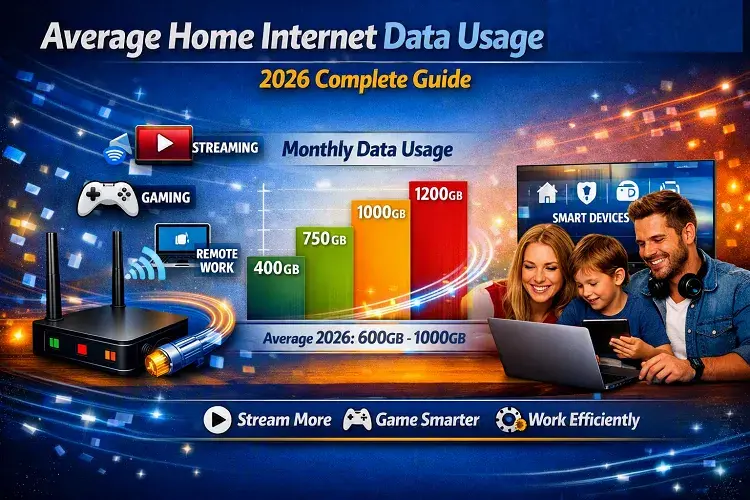
As of 2026, the average home internet data usage in the United States has reached approximately 711 GB (Gigabytes) per month per household. Driven by 4K video streaming, cloud synchronization, and connected smart home devices, nearly 25% of all American households are now classified as “power users,” consuming more than 1 TB (Terabyte) of data every single month.
If you are signing up for a new internet plan, you might notice that some providers offer “Unlimited Data,” while others enforce a “Data Cap” (usually around 1.2 TB). If you exceed that cap, you could be hit with unexpected overage fees on your next bill.
But how much data do you actually need? Can a family of four survive on a capped internet plan, or do you absolutely need to upgrade to unlimited fiber?
In this comprehensive guide, the broadband experts at Compare Internet Hub will break down exactly how much data everyday activities consume, reveal the latest 2026 usage statistics, and explain how to avoid paying penalties to your internet service provider (ISP).
What is a Data Cap (and What Happens if You Go Over)?
A data cap is an artificial limit your provider places on your monthly internet consumption. Providers measure data in Gigabytes (GB) and Terabytes (TB), calculating all the information you download (streaming Netflix) and upload (sending emails or jumping on a Zoom call) from the first day to the last day of your billing cycle.
If you have a data cap and you exceed it, one of two things will happen:
Overage Fees: Cable providers (like Xfinity) will automatically add extra data to your account and charge you a fee. The standard rate in 2026 is $10 for every additional 50 GB you consume, usually maxing out around $100 in penalties.
Data Throttling (Slowdowns): Satellite and Fixed Wireless providers (like HughesNet or older 5G plans) will not charge you extra, but they will dramatically slow your internet to a crawl—often making it impossible to stream video until the next month begins.
(Need to check if the providers at your specific address enforce data caps? Call the Compare Internet Hub dispatch desk at (844) 817-0136 for an instant, free availability check.
2026 Data Usage Statistics: The Rise of the “Power User”
According to the 2026 Broadband Insights Report from OpenVault, our internet habits are changing rapidly. The days of simply checking email and reading news articles are over.
The Average Household: Consumes 711 GB of data per month (a 7.1% increase from 2025).
The Power Users: A massive 23.5% of all subscribers now consume more than 1 TB of data per month, pushing them dangerously close to the data caps enforced by many cable companies.
The Rise of Uploads: One of the biggest shifts in 2026 is upstream traffic. Because of AI-assisted tools, home security cameras uploading 24/7 footage to the cloud, and remote work VPNs, upstream (upload) traffic grew three times faster than downstream traffic this year!
How Much Data Do Your Favorite Activities Use?
To figure out if you will hit a 1 TB (1,000 GB) data cap, you need to understand how much data your digital lifestyle requires.
1. Video Streaming (The Biggest Data Hog)
Video streaming accounts for roughly 65% of all global internet traffic. If you leave the TV on all day for background noise, you are burning through massive amounts of data.
Standard Definition (480p): ~700 MB per hour.
High Definition (1080p): ~3 GB per hour.
Ultra HD (4K): ~7 GB to 10 GB per hour.
(Note: If you stream four hours of 4K video every night, you will consume roughly 1,200 GB in a single month—instantly breaking a 1 TB data cap just from your television alone!)
2. Online Gaming
Playing online multiplayer games (like Call of Duty or Fortnite) surprisingly uses very little data—usually only 100 MB to 300 MB per hour. However, downloading the games is a completely different story. Modern AAA video games often require downloads exceeding 150 GB. If a household has two gamers who regularly download new games and weekly massive patch updates, your data usage will skyrocket.
3. Remote Work & Video Calls
Working from home requires constant data flow.
Zoom / Microsoft Teams: A group video call in High Definition consumes roughly 1.5 GB to 2 GB per hour. If two adults work from home 40 hours a week, that is 160 GB of data strictly dedicated to meetings.
General Web Browsing: Minimal. Checking emails and reading articles uses about 50 MB per hour.
Which Providers Offer Unlimited Data?
If your household consists of multiple heavy streamers, gamers, or remote workers, you absolutely need an Unlimited Data plan to avoid monthly anxiety and hidden fees.
1. Fiber-Optic Providers (Always Unlimited): Because fiber-optic cables use light to transmit data and have practically limitless bandwidth, nearly all fiber providers offer truly unlimited data with zero caps and zero throttling.
Top Picks: AT&T Fiber, Frontier Fiber, Verizon Fios, Quantum Fiber, Google Fiber.
2. Cable Providers (Mixed Bag): Cable companies are split on this issue.
Spectrum: Known for offering unlimited data on all of their standard cable tiers.
Xfinity & Cox: Frequently impose 1.2 TB data caps on their standard plans, requiring customers to pay an extra fee (usually around $30/month) to “upgrade” to unlimited data.
3. Fixed Wireless & Satellite
T-Mobile 5G Home Internet: Offers unlimited data, though speeds may be deprioritized during heavy cellular tower congestion.
Starlink / Viasat: Premium tiers offer unlimited data, though lower tiers may still enforce “priority data” limits.
FAQ: Managing Your Monthly Data
How can I check my monthly internet data usage?
You can check your exact data usage by logging into your internet service provider’s mobile app or online customer portal. Providers like Xfinity and Cox feature a real-time data usage meter on your dashboard, and they will typically send you an automated email or text message when you reach 75%, 90%, and 100% of your monthly data allowance.
Can I lower my data usage without stopping my Netflix streaming?
Yes, you can dramatically lower your data usage by adjusting the playback settings inside your streaming apps. By logging into Netflix, Hulu, or YouTube and changing the default playback quality from “4K / Ultra HD” down to standard “1080p HD”, you will cut your data consumption by more than 50% without a highly noticeable drop in visual quality on smaller televisions.
Is 1.2 TB of data enough for a family of four?
In 2026, 1.2 TB is generally cutting it very close for a family of four. If the parents work from home on video calls and the children stream YouTube and download large Xbox or PlayStation games, it is highly likely that a family of four will exceed 1.2 TB and incur overage fees.
Stop Paying Overage Fees: Find an Unlimited Plan Today
If your current provider is constantly hitting you with $20 to $50 in overage fees every month, it is time to switch to a provider that offers true unlimited data. Because fiber networks are expanding rapidly, you might have new, uncapped options available at your address that weren’t there last year.
Want to find an unlimited data plan in your ZIP code? Do not let data caps dictate how you use the internet. Call the broadband experts at Compare Internet Hub today at (844) 817-0136 or use our free ZIP code search tool. We will instantly check your address for unlimited fiber and cable options and help you lock in a better rate.
Updated on: September 14, 2026