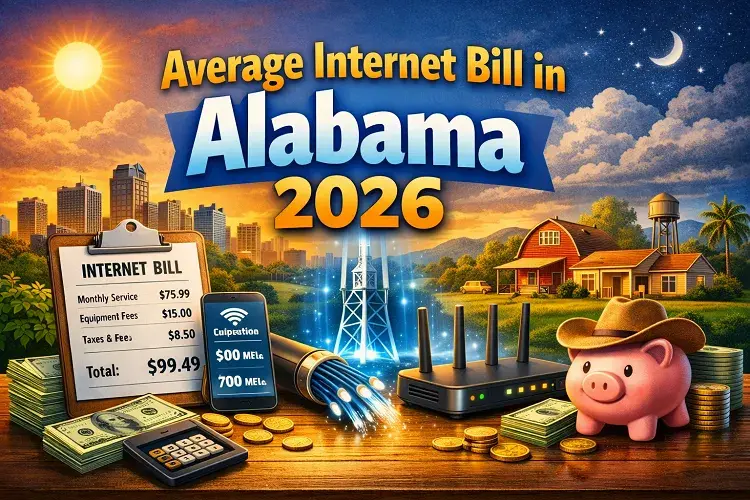
The average Alabama internet bill is around the $61–$81 per month range, depending on the data source and whether bundled services are included.
Multiple independent cost-tracking sources converge on a similar range. Industry pricing trackers put the average Alabama internet bill at $80.98 per month, about 8% above the national average of $75. A separate utility-cost analysis of Alabama found residents paying around $72 per month for internet service, while a broader cost-of-living breakdown for 2026 estimated the figure closer to $61.40 per month. Taken together, these figures suggest most Alabama households can expect a realistic range of roughly $60 to $85 per month for standalone internet service, with the exact number depending heavily on provider, technology type, and location.
This article breaks down what drives that price, how Alabama compares to the rest of the country, which factors push bills higher in different parts of the state, and what options exist for households trying to lower their monthly cost. For residents comparing providers and plans, compareinternethub.com compiles current pricing and availability information by area, which can help narrow down realistic options before committing to a plan.
- The average Alabama internet bill falls in the $61–$81 per month range, depending on the data source and whether bundled services are included.
- Alabama ranks 8% above the national average internet cost despite a lower overall cost of living.
- Only about 77.6% of Alabama residents have access to wired or fixed wireless broadband meeting the FCC’s 25 Mbps/3 Mbps minimum threshold, well below access rates in many other states.
- Roughly three in ten Alabama residents cannot purchase broadband for $60 per month or less, excluding promotional pricing.
- Fiber availability remains limited statewide, with broadband data showing fiber reaching only about 12.4% of the population.
- A $1.4 billion federal infrastructure investment is underway and expected to materially change pricing and access by the late 2020s.
- Bundling, negotiating, and timing a plan switch around promotional periods are the most reliable near-term ways to reduce a bill.
Main Analysis: What Alabama Households Actually Pay
Why Do Estimates Vary So Much?
Anyone researching this topic will notice that “average internet bill in Alabama” doesn’t return one clean number — it returns a range. That’s normal, and it has a straightforward explanation: different organizations measure different things.
Some trackers calculate a blended average across every internet subscription in the state, including older legacy plans, DSL, satellite, and premium fiber tiers. Others calculate the cheapest available plan at each address, which produces a lower figure. Cost-of-living indexes often average self-reported spending from surveys, which tends to land somewhere in the middle. A national utility-cost report that ranked Alabama among the five most expensive states for overall utilities found residents paying about $72 per month for internet, alongside $143 for electricity, $90 for natural gas, and $66 for phone service. None of these figures is “wrong” — they’re answering slightly different questions.
For practical budgeting purposes, a household shopping for a standard cable or fiber plan with moderate speed (100–500 Mbps) should expect a starting price in the $30–$60 range before equipment fees, taxes, and promotional period expiration, climbing toward $70–$100 for higher-tier or bundled service.
How Alabama Compares to the National Average
The clearest comparative data point comes from state-level pricing analysis, which places the Alabama average 8% above the $75 national average, despite the state’s cost of living running roughly 12% below the U.S. average overall. That’s an unusual combination — most categories of spending in Alabama are cheaper than the national norm, but internet service is one of the few where residents pay a premium.
| Cost Category | Alabama (2026 estimate) | Notes |
|---|---|---|
| Internet (blended average) | $61–$81/month | Varies by source and methodology |
| Electricity | ~$126–$143/month | Among the highest in the U.S. |
| Natural gas | ~$90/month | Elevated due to summer cooling demand |
| Water & sewer | ~$57–$89/month combined | Near national norms |
| Overall utility bill | ~$575–$610/month | Ranks Alabama among the top 5 most expensive states for utilities |
This pattern is consistent with how multiple utility-cost researchers describe Alabama: a state where hot summers drive some of the highest electricity bills in the country, and where internet costs, while not the largest line item, still run above what residents in most other states pay for comparable service.
What Drives the Price Difference
Three structural factors explain most of the premium Alabama residents pay for internet access.
1. Limited fiber buildout. Fiber is generally the cheapest technology per megabit once installed, because it has lower maintenance costs and higher capacity than copper-based DSL or satellite. But broadband infrastructure data shows fiber reaches only about 12.4% of Alabama’s population, while DSL covers 82.9% and cable covers 80.6%. That leaves a large share of the state relying on older, more expensive-to-maintain infrastructure, which keeps average pricing higher than in states with more extensive fiber networks.
2. Limited competition in many areas. Pricing tends to fall wherever multiple providers compete for the same customers. Alabama broadband data indicates that less than 33% of the state has three or more wired providers to choose from. In single-provider or two-provider markets, there’s less pressure to offer aggressive promotional pricing or hold rates steady after an introductory period ends.
3. Rural geography. Alabama’s population is spread across a large rural footprint, and extending wired infrastructure to low-density areas costs significantly more per household than in dense urban corridors. This is a familiar pattern nationally — research comparing internet costs by state found that states with wide-open, low-density geography (Alaska, Montana, West Virginia) tend to have the highest price-per-megabit, while densely populated eastern seaboard states tend to have the lowest. Alabama’s rural stretches follow a similar logic, even though the state as a whole isn’t classified among the very highest-cost states.
Price by Technology Type
Not all internet service in Alabama costs the same, and the technology delivering the connection matters as much as the provider.
- Fiber: Where available, fiber tends to offer the best value per megabit, with competitive markets showing entry pricing as low as $30–$35/month for gigabit-class symmetrical speeds.
- Cable: The most widely available wired technology in the state, typically priced from $30–$50/month for entry tiers, rising for higher speed tiers.
- Fixed wireless (5G home internet): A newer, increasingly available option from carriers, generally priced around $30–$65/month with growing rural coverage.
- Satellite: The fallback option in the most remote areas, with traditional satellite plans starting around $65/month for speeds up to 25 Mbps under two-year contracts, while newer low-earth-orbit satellite service runs closer to $115/month for significantly faster speeds with no contract.
This technology mix matters because a meaningful share of Alabama households don’t have a real choice between these tiers — their address determines which of these categories is even available to them.
Research Insights: The Access Gap Behind the Price Gap
A complete picture of Alabama’s internet costs has to account for access, not just price. The two are connected: where access is limited, pricing power shifts toward providers.
Independent broadband research found that Alabama ranks 44th among U.S. states in a composite measure of coverage, speed, and availability. Only about 77.6% of residents have access to wired or fixed wireless broadband meeting the FCC’s minimum definition of 25 Mbps download and 3 Mbps upload — meaning roughly one in five Alabamians technically cannot purchase a connection that meets even this modest federal threshold.
Affordability access is a separate problem from raw availability. The same research found that nearly three in ten Alabama residents are unable to purchase broadband for $60 per month or less, excluding promotional rates and government subsidy programs. That statistic helps explain why average bills run above the national norm: a meaningful share of the state doesn’t have a low-cost option available at their address, regardless of how well they shop around.
Geography plays a large role in who experiences this gap. County-level data show access concentrated around the state’s metro corridors — Jefferson County (Birmingham metro) and Shelby County report broadband access rates of 99% and 97%, respectively, at speeds of 100 Mbps or higher, with the Huntsville, Montgomery, and Auburn metro areas rounding out the highest-access counties. Perry County, the state’s least populous county, has the lowest rate of high-speed broadband access in Alabama. This urban-rural divide is the single clearest pattern in Alabama’s broadband landscape: residents in or near the state’s five major metro areas generally have multiple competing options, while rural counties often have one or two, if any.
One earlier analysis of household connectivity put a sharper point on the consumer impact, estimating that despite average bills near $74 per month, roughly two in five Alabama homes remain offline altogether — a figure that reflects both affordability barriers and outright unavailability in parts of the state.
Consumer Impact: What This Means for Alabama Households
For the average Alabama family, internet service typically lands as the third-largest monthly utility expense after electricity and natural gas, and it now functions as a near-essential service rather than a discretionary one — required for remote work, telehealth appointments, school assignments, and job applications that have moved almost entirely online.
Households on tighter budgets face a particular bind: the same lack of competition that keeps prices elevated also limits the ability to “shop around” in many rural zip codes. A household in a competitive metro market might have five or more providers to choose between, with promotional pricing wars driving entry-level rates toward $30/month. A household in an underserved rural county might have exactly one wired option, with no comparable plan to switch to if the price rises.
This unevenness also affects how useful “the average” is as a planning number. A reasonable approach for any Alabama household is to:
- Check actual address-level availability rather than relying on statewide averages, since pricing and provider options vary block by block in many areas.
- Compare the total first-year cost of a plan, not just the advertised promotional rate, since most promotional pricing expires after 12 months.
- Ask directly about equipment rental fees, installation charges, and early termination fees, which can add $10–$20 or more to the effective monthly cost.
- Confirm whether a household qualifies for the Lifeline program or low-cost plans such as Xfinity Internet Essentials, which can meaningfully reduce the bill for income-eligible households.
Households evaluating multiple providers can use a comparison resource like compareinternethub.com to check plan and pricing details by location, and can call (844) 817-0136 to ask a representative about current availability and promotional offers in their specific area.
FAQ
What is the average internet bill in Alabama in 2026?
Estimates range from about $61 to $81 per month depending on the data source and methodology used. Most pricing trackers place the figure in the upper end of that range, roughly 8% above the $75 national average, while broader cost-of-living indexes that include promotional and discount pricing tend to land closer to the lower end.
Why is internet more expensive in Alabama than the national average?
Limited fiber availability, reduced provider competition in many areas, and the cost of serving a largely rural population all contribute. Fiber, the lowest-cost-per-megabit technology, reaches only about 12% of Alabama’s population, leaving many residents dependent on costlier legacy infrastructure or satellite service.
Which internet providers are available in Alabama?
Alabama has more than 25 internet service providers statewide, including national carriers like AT&T, Spectrum, and T-Mobile Home Internet, regional cable providers, electric cooperative fiber networks, and satellite providers such as Viasat, HughesNet, and Starlink. Availability varies significantly by address, particularly in rural counties.
Is fiber internet available throughout Alabama?
No. Fiber currently reaches roughly 12% of the state’s population, concentrated mainly in and around metro areas like Birmingham, Huntsville, Montgomery, and Auburn. New federal and state funding is expected to expand fiber access substantially over the next several years, with the majority of new BEAD-funded projects using fiber technology.
What is the cheapest way to get internet in Alabama?
Entry-level cable and fixed-wireless plans offer the lowest standalone pricing, often starting around $30 per month before promotional periods expire. Income-eligible households may also qualify for the Lifeline program or discounted plans such as Xfinity Internet Essentials, which can lower costs further.
Did the Affordable Connectivity Program (ACP) help lower Alabama internet bills?
The ACP previously provided internet subsidies to qualifying households but ended in mid-2024 after Congress did not renew its funding. Households that previously relied on ACP discounts may still qualify for the longer-running Lifeline program, which offers a smaller monthly credit.
How many Alabama households lack broadband access?
Roughly 22% of Alabama residents lack access to wired or fixed wireless broadband meeting the FCC’s minimum 25 Mbps/3 Mbps definition. Nearly three in ten residents cannot purchase broadband for $60 per month or less at their address, even before accounting for outright unavailability in some rural areas.
Will Alabama internet prices go down soon?
Pricing pressure is expected to ease gradually as new infrastructure comes online. Alabama’s $1.4 billion BEAD allocation and existing state broadband funds are funding fiber expansion to roughly 92,000 currently unserved locations, with new competition from electric cooperatives likely to push prices down in markets that currently have limited provider choice. Most projects are expected to go live starting in late 2026.
Conclusion
Alabama’s average internet bill sits modestly but consistently above the national average, driven less by any single provider’s pricing strategy than by structural factors: limited fiber penetration, thin competition in large parts of the state, and the basic economics of serving a rural population. The good news for residents is that this is an active area of investment rather than a static problem — more than $1.5 billion in combined federal and state funding is currently being deployed specifically to expand fiber access and introduce new competitive options in underserved counties.
In the meantime, the most effective lever available to most households is comparison shopping at the address level, since statewide averages can obscure wide swings in both price and availability from one zip code to the next. Resources like compareinternethub.com can help residents check current plans and pricing for their specific location, and calling (844) 817-0136 is a direct way to confirm what’s actually available before committing to a provider.
More Internet Billing & Connectivity Guides
Compare State Averages: Are you overpaying for broadband? Compare your monthly statement against the Average Internet Bill in Utah and the Average Internet Bill in Alabama to see if it is time to switch providers.
Find Discounts & Specialized Plans: Don’t get caught off guard by price hikes—find out How Much Frontier Internet Costs After 12 Months. Also, check out our curated lists for Internet Provider Discounts for Students and the absolute Best Internet Plans for Remote Workers.
Updated on: August 1, 2026