2026 Head-to-Head Verdict
AT&T vs. Verizon: Which Wins in 2026?
Verizon: 4.8 / 5 ⭐
The Bottom Line: If you are choosing between pure fiber connections (AT&T Fiber vs. Verizon Fios), this is a statistical tie. Both deliver 100% symmetrical speeds, 99.9% reliability, zero data caps, included Wi-Fi 6 hardware, and no annual contracts starting at $49.99–$55/mo. Because their fiber footprints rarely overlap, your choice is dictated by geography: Verizon dominates the Northeast and Mid-Atlantic, while AT&T covers the Southeast, Midwest, and West. If you need 5G Home Internet, Verizon wins on speed and Ultra Wideband coverage.
Choose AT&T If:
- You live in the South, Midwest, or California
- You want extreme multi-gigabit speeds up to 5,000 Mbps
- You already have an AT&T Unlimited wireless phone plan
Choose Verizon If:
- You live in the Northeast (NY, NJ, PA, MA, MD, VA, DC)
- Fiber is unavailable and you want top-tier 5G Home Internet
- You qualify for Verizon mobile bundling (\$35/mo plans)
Unlike comparing a modern fiber provider to a legacy cable company (where the winner is obvious), AT&T and Verizon operate on nearly identical, cutting-edge technological foundations. Both companies offer world-class, pure fiber-optic networks, and both companies have recently launched aggressive 5G Fixed Wireless Access (FWA) products for users who cannot get fiber.
So, how do you choose? The decision comes down to hyper-local availability, gateway hardware, and the massive financial leverage of the "Mobile Bundle."
Flagship Fiber & 5G Air
AT&T Internet
With AutoPay & Paperless Bill
- Speeds from 300 to 5,000 Mbps
- 100% symmetrical fiber upload & download
- No data caps, contracts, or router rental fees
- BGW320 Wi-Fi 6 Gateway included
Fios Fiber & 5G Home
Verizon Internet
(\$35/mo with select 5G mobile plans)
- Speeds from 300 to 2,300 Mbps
- 100% symmetrical Fios fiber infrastructure
- Zero data limits or early termination fees
- Verizon CR1000A Wi-Fi 6E Router included
Here is the complete Compare Internet Hub engineering breakdown of AT&T vs. Verizon for 2026.
1. The Heavyweights: AT&T Fiber vs. Verizon Fios
AT&T Fiber vs. Verizon Fios: Speed Tiers & Monthly Pricing
2026 Pure Fiber Matchup
| Speed Tier | AT&T Fiber Price | Verizon Fios Price | Upload / Download | Order Action |
|---|---|---|---|---|
| 300 Mbps Plan Everyday Streaming & WFH |
$55.00/mo | $49.99/mo | 300 / 300 Mbps (Symmetrical) | Call AT&T View Verizon |
| 500 Mbps Plan Multi-Device Households |
$65.00/mo | $69.99/mo | 500 / 500 Mbps (Symmetrical) | Call AT&T View Verizon |
| 1 Gig (1,000 Mbps) ⭐ Top Recommendation |
$80.00/mo | $89.99/mo | 1,000 / 1,000 Mbps | Order AT&T Order Verizon |
| 2 Gig / 2.3 Gig Creators & Gamers |
$145.00/mo | $109.99/mo (2.3 Gig) | 2,000 – 2,300 Mbps | Call AT&T View Verizon |
| 5 Gig Tier Ultimate Multi-Gigabit |
$245.00/mo | Not Available | 5,000 / 5,000 Mbps | Get AT&T 5 Gig |
*Pricing includes AutoPay & Paperless billing discounts. Zero contracts, no data caps, and included Wi-Fi gateway hardware with both providers.
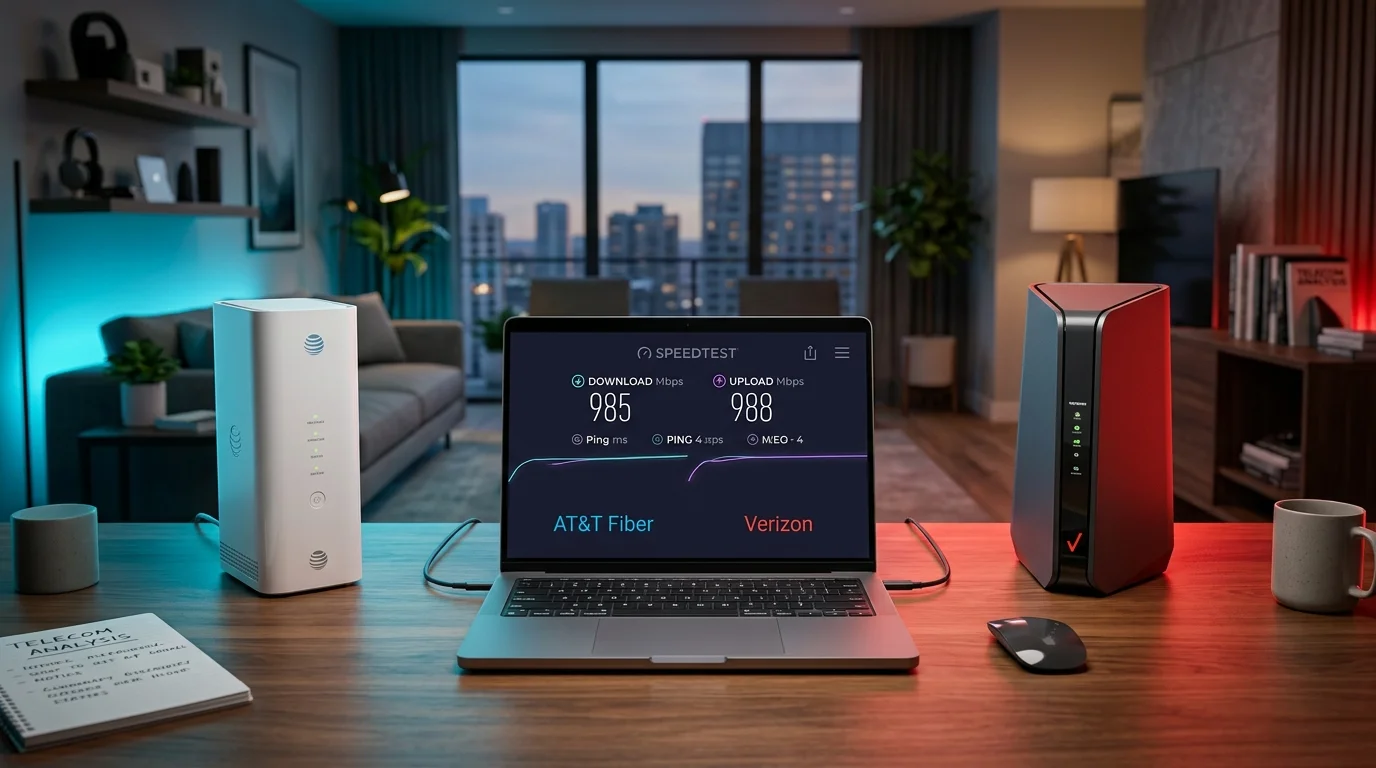
If you live in an urban or suburban area where these two companies have buried glass cables, you are looking at their flagship products: AT&T Fiber (running on XGS-PON technology) and Verizon Fios (Fiber-to-the-Home / FTTH).
The Ultimate Tie: Symmetrical Speeds & No Data Caps
In the broadband industry, it is rare to find two companies that perfectly match each other in raw performance, but AT&T Fiber and Verizon Fios are virtually identical.
- Symmetrical Uploads: Both networks provide symmetrical speeds. If you purchase a 1 Gigabit plan from either company, you will receive 1,000 Mbps of download speed and 1,000 Mbps of upload speed. For remote workers, content creators, and competitive gamers, this guarantees zero lag.
- Zero Data Caps: Both AT&T Fiber and Verizon Fios enforce zero data caps. You can stream 4K video 24/7 without ever paying an overage fee.
- No Annual Contracts: Neither company forces you into a predatory 2-year contract with early termination fees.
The Differentiator: Hardware and Security
Because the networks are identical in speed, we must look at the hardware they provide.
- AT&T BGW320 Gateway: AT&T includes the BGW320, a Wi-Fi 6 powerhouse with the Optical Network Terminal (ONT) built directly inside. Crucially, it includes AT&T ActiveArmor, an enterprise-grade security software that actively blocks hackers from accessing vulnerable smart home devices.
- Verizon CR1000A Router: Verizon provides the CR1000A, which also natively supports Wi-Fi 6E. While it lacks the built-in ActiveArmor software that AT&T provides, the Verizon router is slightly more "open" for advanced homelab enthusiasts who want to configure complex IP Passthrough setups.
2. The Wireless Backup: 5G Home Internet vs. Internet Air
What happens if you do not live in a fiber-optic zone? Both companies have a massive backup plan. Instead of burying cables, they will mail you a sleek wireless hub that pulls a high-speed internet signal directly from their local 5G cell phone towers.
- Verizon 5G Home Internet: Verizon has heavily leveraged its massive C-Band and mmWave spectrum. If you are near a Verizon Ultra Wideband tower, you can pull near-gigabit speeds out of thin air. Verizon’s 5G gateway is highly regarded for its stability during peak evening hours.
- AT&T Internet Air: AT&T's answer is Internet Air. It is incredibly easy to set up ("Plug and Play") and provides excellent speeds for standard 4K streaming and daily work-from-home tasks. However, its footprint is currently slightly smaller than Verizon's 5G network in rural areas.
5G Wireless Showdown: Verizon 5G Home Internet vs. AT&T Internet Air
| Feature | Verizon 5G Home Internet | AT&T Internet Air |
|---|---|---|
| Wireless Network | 5G Ultra Wideband (C-Band & mmWave) | 5G Mid-Band Spectrum |
| Typical Download Speeds | 85 – 300 Mbps (Up to 1,000 Mbps on 5G Plus) | 75 – 225 Mbps |
| Typical Upload Speeds | 10 – 50 Mbps | 10 – 25 Mbps |
| Latency Range | 20ms – 35ms | 25ms – 45ms |
| Price with Qualifying Mobile | $35.00/mo ($15-$25 off) | $35.00/mo ($20 off) |
| Standalone Price | $50 – $70/mo | $60.00/mo |
| Category Winner | 🏆 Winner (Faster Speeds & Wider 5G Footprint) | Solid Alternative If Fiber Unavailable |
3. The Financial Decider: The Mobile Bundle
If both companies offer 1 Gigabit Fiber, and both companies offer excellent Wi-Fi 6 routers, how do you actually make the final choice?
You choose the company that provides your cell phone service.
In 2026, both AT&T and Verizon are desperately trying to lock customers into their ecosystem by offering massive "Mobile Bundles."
- If you already have a qualifying Verizon Unlimited cell phone plan, Verizon will slash the price of its Fios or 5G Home Internet. You can often lock in your home internet for as low as $70/month combined.
- If you are an AT&T Wireless customer, AT&T offers similar, massive discounts (often 20% off your monthly internet bill) when you link your mobile and home internet accounts.
Final Verdict: Which Should You Choose?
In the battle of AT&T vs. Verizon, the consumer is the ultimate winner. This is a dead tie.
If you have access to AT&T Fiber or Verizon Fios, you are getting the absolute best internet technology available in the world today. Your final decision should be based entirely on two factors:
- Availability: Check your address. Often, only one of these fiber networks is available on your specific street.
- Your Cell Phone Provider: Pick the internet company that matches your cell phone carrier to unlock massive monthly discounts.
Stop dealing with buffering cable companies. Click below to instantly verify which of these two telecom giants is available at your home: