Quick Answer: Frontier Fiber vs. Spectrum Cable
Frontier Fiber is the clear winner in head-to-head performance wherever its pure fiber network is built. Frontier delivers symmetrical upload and download speeds (up to 7,000 Mbps), lower gaming latency (~5 ms), and includes Amazon eero Wi-Fi 7 routers with zero monthly rental fees. However, Spectrum Cable is the winner if Frontier only offers legacy DSL at your home—Spectrum's 500–1,000 Mbps cable network vastly outperforms copper DSL.
✓ Spectrum: Best for Rural Availability & Mobile Bundles
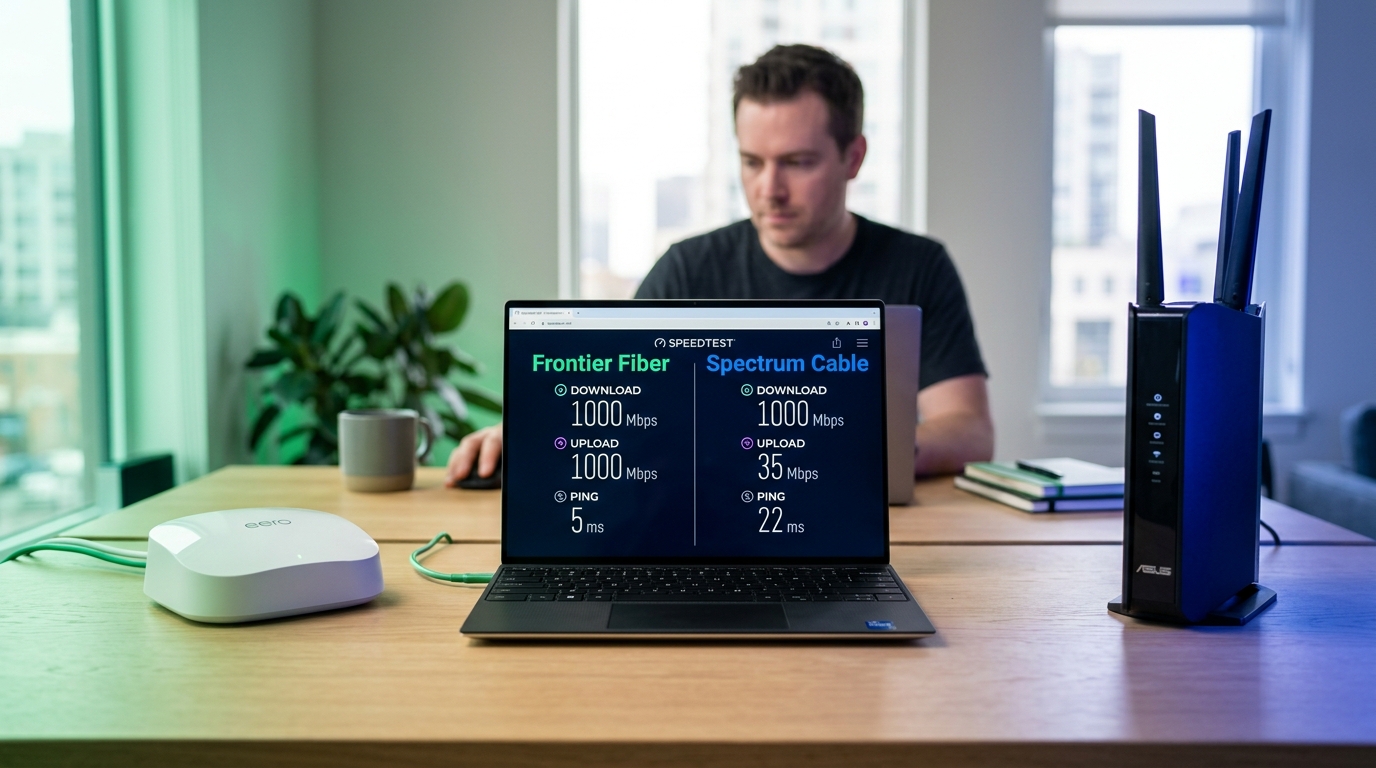
If you live in a market where both Frontier and Spectrum are available, you are in a very fortunate position. Unlike many Americans who are trapped with only one terrible internet option, you get to choose between two of the largest telecommunications giants in the country.
However, comparing Frontier and Spectrum is not an apples-to-apples comparison. It is an Apples-to-Oranges comparison because these two companies use completely different physical infrastructure to deliver internet to your home.
Spectrum uses legacy Coaxial Cable, while Frontier uses pure fiber optics.
Here is the complete Compare Internet Hub engineering breakdown of Frontier vs. Spectrum, the hidden pricing traps, and exactly which one you should choose based on your household's internet usage.
Want to skip the reading? Call our 24/7 Dispatch Center to instantly check which provider services your exact street address:
Frontier Fiber
- Speeds from 500 to 7,000 Mbps
- Equal, symmetrical uploads & downloads
- $0 Data caps & Free Amazon eero Wi-Fi 7
Spectrum Internet
- Gigabit download speeds up to 1,000 Mbps
- 95%+ Suburban & rural availability
- No contracts + Free modem included
1. The Technology: FTTH vs. HFC
The biggest difference between these two providers is the physical wire buried in your front yard.
Frontier: Pure Fiber-Optic (FTTH)
Frontier is actively spending billions of dollars upgrading their old DSL network to Fiber-to-the-Home (FTTH). This means they run a pure glass fiber-optic line directly into the side of your house. Because fiber uses light to transmit data, it is virtually immune to weather interference and network congestion.
- Symmetrical Speeds: Because it is pure fiber, Frontier offers symmetrical speeds. If you pay for 1 Gigabit (1,000 Mbps) download, you also get 1 Gigabit (1,000 Mbps) upload.
Spectrum: Hybrid Fiber-Coaxial (HFC)
Spectrum uses a legacy HFC network. They run fiber-optics to your neighborhood, but the "last mile" of wiring that actually connects to your house is a copper coaxial cable (the same wire used for cable TV).
- Asymmetrical Speeds: Copper cannot handle the same massive data loads as fiber. Therefore, Spectrum’s speeds are asymmetrical. While they offer massive 1 Gigabit download speeds, their upload speeds are brutally throttled (often capping out at just 35 Mbps).
The Winner: Frontier. Pure fiber-optics will always defeat copper coaxial cable in a technical shootout.
Frontier Fiber vs. Spectrum Cable: Head-to-Head Comparison
2. The Dealbreaker: Data Caps
One of the most predatory practices in the internet industry is the "Data Cap." Companies like Cox and Comcast Xfinity will aggressively charge you massive overage fees if you download too much data in a single month.
Fortunately, this is a rare category where both companies tie.
- Frontier: $0 data caps on all Fiber plans.
- Spectrum: $0 data caps on all plans.
Whether you choose Frontier or Spectrum, you can stream 4K Netflix, download massive video games, and run security cameras 24/7 without ever worrying about a surprise overage fee on your bill.
3. Equipment Fees and Hidden Costs
Both companies require a Modem to decode the internet signal, and a Wi-Fi Router to broadcast the signal through your house. How they charge for this equipment is vastly different:
- Frontier: Frontier includes the Wi-Fi router (often a high-end Eero Mesh system) completely for free with their Fiber plans. This is a massive value add that saves you hundreds of dollars a year.
- Spectrum: Spectrum provides the Modem for free, but they charge a monthly rental fee (usually around $7/month) if you want to use their "Advanced Wi-Fi Router."
Popular 2026 Plans & Pricing Matchup
*Pricing reflects promotional introductory rates with AutoPay and Paperless Billing enabled. Speeds and availability vary by exact address.
4. Availability: The Rural Divide
While Frontier dominates in technology, Spectrum dominates in sheer availability.
Frontier’s Fiber-Optic network is still being built. It is primarily available in densely populated cities and specific suburban footprints. If you live in a rural area or an older neighborhood, Frontier might only offer its legacy "DSL" internet, which is incredibly slow (often under 25 Mbps) and should be avoided at all costs.
Spectrum, because they use the existing cable television infrastructure, is available to tens of millions of homes across America, including deep rural pockets.
Final Verdict: Which Should You Choose?
Because these two companies use completely different technology, the choice is actually very simple once you know what is physically buried under your street.
- Choose Frontier If: You are lucky enough to have their Fiber-Optic network available at your address. If you work from home, upload YouTube videos, or have a smart home, Frontier’s symmetrical speeds and free Wi-Fi equipment make it the undisputed winner.
- Choose Spectrum If: Frontier Fiber is not available at your address, and your only other option is Frontier DSL. Spectrum's coaxial network is massively faster and more reliable than legacy DSL.
Frequently Asked Questions: Frontier vs. Spectrum
Is Frontier Fiber faster than Spectrum Cable?
Yes. Frontier offers 100% symmetrical speeds up to 7,000 Mbps download and 7,000 Mbps upload. Spectrum Cable maxes out at 1,000 Mbps download and caps upload speeds between 20 and 35 Mbps. For file sharing, video conferencing, and online gaming, Frontier Fiber is significantly faster.
Do Frontier or Spectrum have data caps?
Neither provider enforces data caps. Both Frontier Fiber and Spectrum Internet include 100% unlimited data on every plan, meaning no overage charges, surprise fees, or throttled speeds.
What should I do if Frontier only offers DSL at my house?
Choose Spectrum Cable without hesitation. Frontier DSL runs across vintage copper telephone wires and maxes out around 12–25 Mbps, whereas Spectrum Cable delivers 500 to 1,000 Mbps. Only pick Frontier if their Fiber network is available at your street address.
How do I check which provider serves my exact street address?
Broadband availability varies street-by-street. Call our dispatch hotlines to verify: to check Frontier Fiber availability, dial (888) 217-6472; to check Spectrum Cable availability, dial (844) 817-0136.
Ready to order? Don't rely on generic coverage maps. Call our 24/7 Dispatch Center to instantly verify which provider offers the fastest speeds at your exact street address:
📞 To Order Frontier Fiber: Dial (888)217-6472
📞 To Order Spectrum Cable: Dial (844) 817-0136